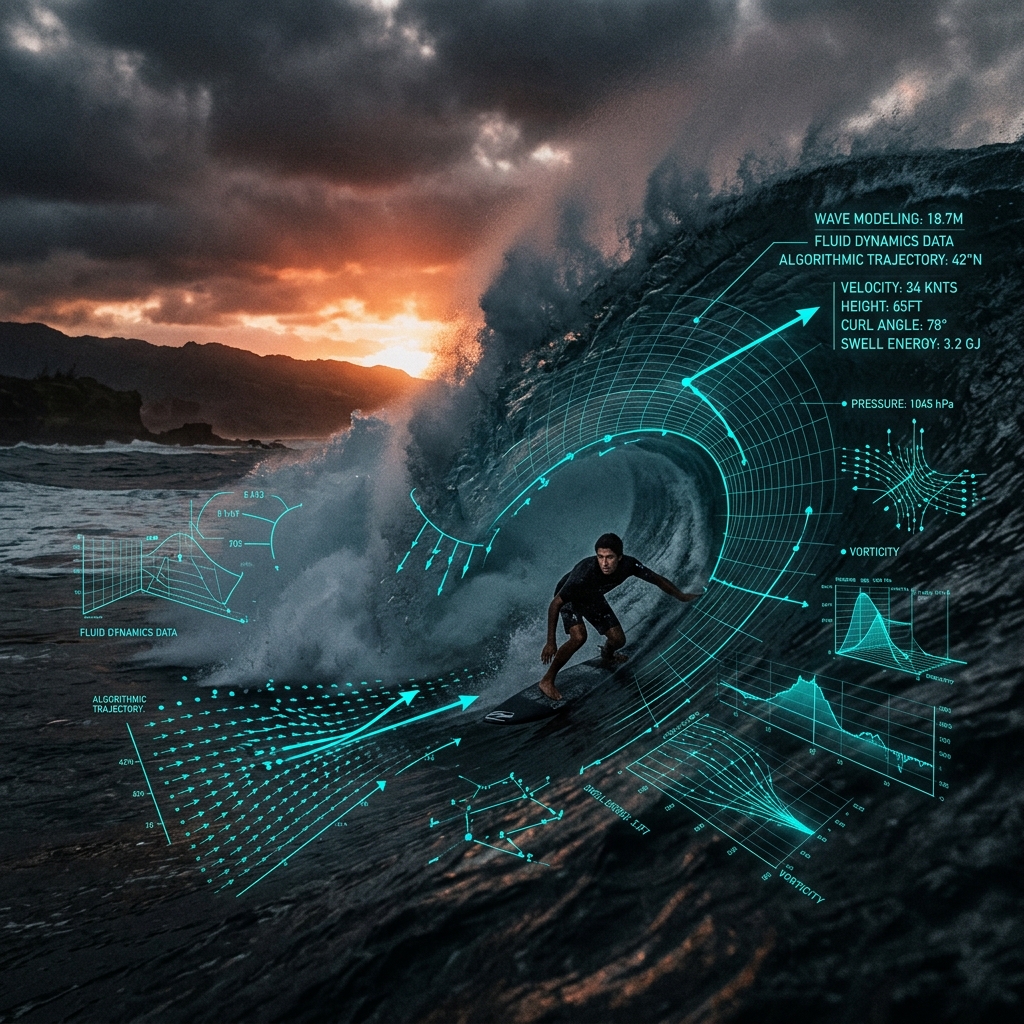
Since the beginning, surfing has been an intimate dialogue between man and the ocean, a discipline governed by intuition, reading the water, and an almost primal instinct. But in the era of artificial intelligence and big data, this dialogue is transforming. Waves are no longer just unpredictable walls of water; they have become complex equations that algorithms take pleasure in solving. Welcome to the era of quantitative surfing, where wave modeling and the search for the ideal trajectory are redefining the limits of professional sports.
The introduction of cutting-edge technologies in high-level surfing is not new, but the pace of innovation has accelerated. World Surf League (WSL) judges increasingly rely on objective data to tie-break athletes, while surfers themselves use digital twins to simulate their maneuvers before even touching the salt water.
Fluid Physics in the Age of Deep Learning
Modeling a wave is one of the most formidable challenges in fluid mechanics. The ocean is a chaotic environment, subject to winds, tides, underwater topography, and thermal currents. Until recently, traditional mathematical models (like the Navier-Stokes equations) required phenomenal computing power for results that struggled to be generated in real time.
The arrival of Deep Learning and Physics-Informed Neural Networks (PINNs) has changed the game. Today, startups specialized in "Wave Dynamics" train AI on petabytes of video data, bathymetric measurements, and satellite readings. The result? An unprecedented ability to predict the shape, speed, and breaking point of a specific wave with centimeter accuracy, hours before it hits the reef.
This granular understanding of fluid dynamics allows coaches to analyze not only the potential of a surf spot but also anticipate the perfect section to place an aerial or a deep barrel. Uncertainty gives way to surgical planning.
Biometric Sensors and Connected Boards
To exploit these algorithmic wave models, one must understand how the surfer interacts with them. This is where biometric sensors and IoT (Internet of Things) integrated into the equipment come in.
The modern surfboards of the world elite are no longer just laminated foam blanks. They are equipped with micro-accelerometers, 6-axis gyroscopes, and pressure sensors distributed under the pad and on the rails. These "smart-boards" record thousands of data points per second: angle of attack, force applied on the fin, glide speed, board flex.

Coupled with connected watches measuring heart rate, blood oxygenation, and thermal stress, these data create a complete biomechanical profile of the surfer. Once crossed with wave modeling, the AI algorithm is capable of identifying micro-errors in positioning. "If you had pressed 15% harder on your back foot at second 3.2, you would have generated the necessary speed to pass the final section," that's the kind of feedback a pro surfer receives today on their tablet when getting out of the water.
The Algorithm Serving the "Ideal Trajectory"
It's the Holy Grail of competitive surfing: finding the ideal trajectory, the one that maximizes speed, power, and flow. In algorithmic jargon, this is a dynamic constrained optimization problem.
Current artificial intelligence systems generate what is called the "Golden Line". By superimposing the 3D modeling of the wave in real-time and the physical capabilities of the surfer, the AI draws an optimal virtual path on the face of the wave. It calculates the exact take-off point, the angle of the bottom turn to accumulate maximum kinetic energy, and the precise timing of the snap at the top of the wave to throw maximum water.
This technology radically changes training. In artificial wave pools (like Kelly Slater's Surf Ranch), the perfect reproducibility of the wave allows testing thousands of iterations of the Golden Line. Machine Learning analyzes each attempt, adjusts recommendations, and accelerates the surfer's motor learning in a way that traditional methods could never equal.
Weather Prediction and Next-Generation "Wave Forecasting"
Optimizing the trajectory is useless if you are not in the right place at the right time. "Wave Forecasting" has long been the prerogative of marine meteorologists. Today, AI models are supplanting human forecasts.
Neural networks analyze satellite images of storm formation at the edges of the Pacific. By detecting patterns invisible to the naked eye in the evolution of winds and atmospheric pressures, these algorithms can predict with over 90% certainty the arrival of a specific swell on a particular reef in Hawaii or Tahiti, up to 10 days in advance.
This hyper-predictability is changing the organization of the sport. The "Storm Chasers" (big wave hunters) of the Big Wave Tour now know exactly in which 3-hour window they must get in the water at Nazaré to catch the wave of the decade. AI reduces fatal risks by anticipating wave closures (the famous "closeouts") and by modeling the extreme rip currents generated by 20-meter swells.
The Future of Surfing: Between Human Intuition and Machine Assistance
So, is surfing losing its soul? This is the big question stirring the community. The massive arrival of algorithms, sensors, and AI optimization frightens purists who consider surfing as an art form, a free dance with the elements that cannot be reduced to zeros and ones.
However, the athletes of the new generation see things differently. For them, AI is not a chain that restrains them, but a tool for emancipation. By better understanding the mechanics of waves and their own bodies, they push the physical limits of what is possible. Tricks deemed impossible ten years ago, requiring management of balance and G-forces beyond the norm, are on the verge of being achieved thanks to computer-assisted training.
In the end, the ocean will always have the final say. Artificial intelligence can predict the wave, calculate the ideal trajectory, and analyze the board, but it is indeed the human, alone on their board, who must feel the water, face their fear at the moment of the drop, and live the fraction of a second of eternity inside the barrel. The algorithm proposes, but the surfer disposes. The future of surfing will not be written against the machine, but in perfect symbiosis with it, gliding towards ever more impressive technological horizons.


