Sleep: Generative Audio AI Optimizing Athlete Recovery
Published on May 29, 2026 • Reading time: 8 min

For decades, the optimization of sports performance focused on biomechanics, precise nutrition, and video analysis. But today, the final frontier of global performance is found in complete darkness. Sleep is no longer a passive state: thanks to generative audio AI, it is becoming an active space for recovery that can be modulated in real-time.
In the ruthless ecosystem of high-level sports, the smallest percentage of improvement is worth its weight in gold. While it has long been known that deep sleep (NREM stage 3) is the key moment for growth hormone secretion and tissue repair, controlling this phase seemed impossible. Athletes had to settle for "good practices": darkness, cool temperatures, and sometimes static white noise.
The arrival of generative AI algorithms paired with biometric sensors is disrupting this reality. From the NBA to Formula 1 paddocks, elite teams are investing heavily in dynamic sound generation systems capable of manipulating the very architecture of our nights. This is no longer science fiction: it is applied neural engineering.
The New Paradigm: Acoustic Neuromodulation
To understand the ongoing revolution, we must move beyond the simple notion of "white noise". Traditional meditation apps use pre-recorded loops that are static and blind to the user's physiological state. Generative audio AI, however, operates fundamentally differently: it composes functional "music" or frequencies in real-time.
By analyzing millions of nights using machine learning algorithms, specialized startups have decoded the relationship between certain sound frequencies and brainwaves. The goal? Brainwave entrainment. When a brain is exposed to a specific binaural frequency (for example, a 200 Hz tone in the left ear and 204 Hz in the right ear), it tends to align with the difference, or 4 Hz, which corresponds to Delta waves, those of the deepest sleep.
We are no longer content with masking parasitic noises. Our AI acts like an invisible conductor synchronizing the athlete's brain waves towards healing frequencies.
The real technological breakthrough lies in the generative aspect. The AI doesn't play an MP3; it generates non-repetitive soundscapes, modulating the volume, pitch, tempo, and timbre to the millisecond so the brain never habituates to the stimulus and remains deeply immersed in the targeted sleep stage.

The Real-Time Biometric Feedback Loop
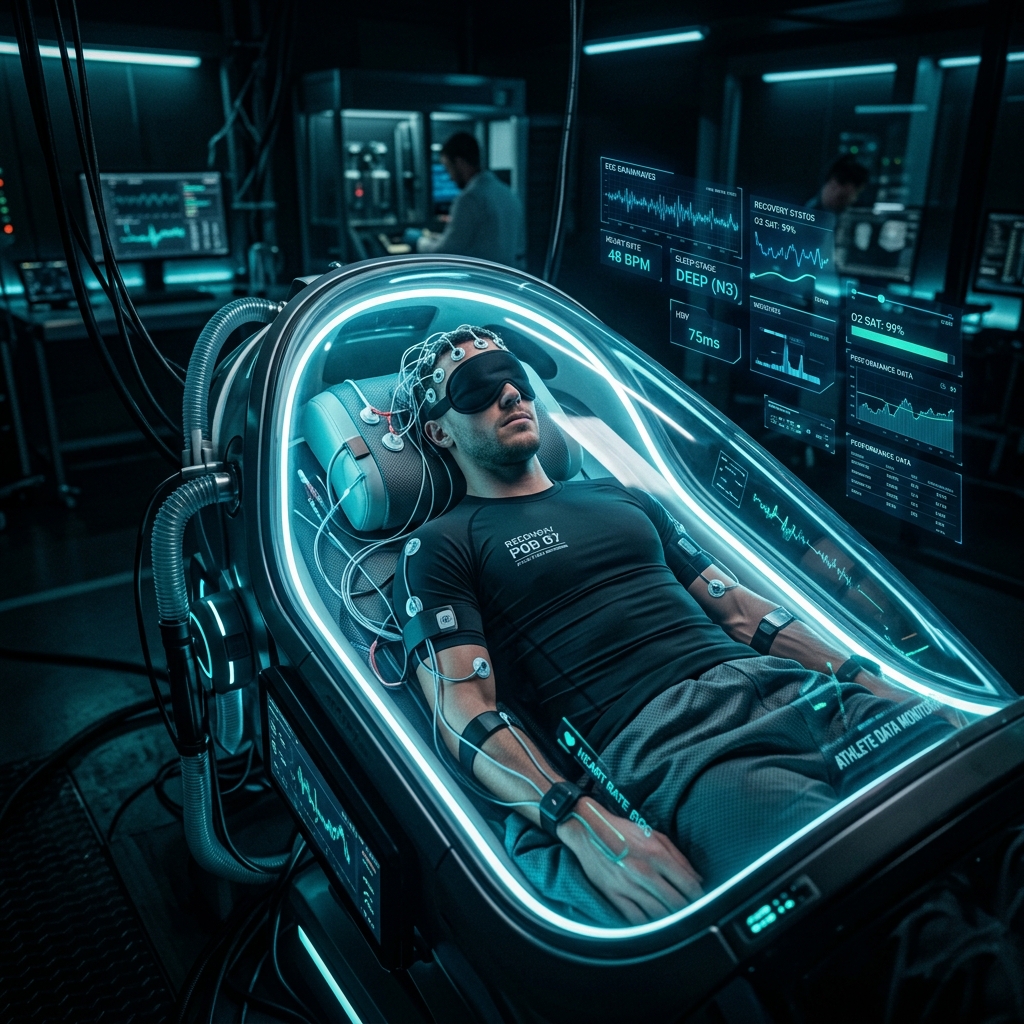
The intelligence of these audio systems would be useless without eyes and ears. This is where fusion with wearables comes in. Devices like Oura rings, Whoop bands, or next-generation EEG headbands continuously track heart rate, heart rate variability (HRV), body temperature, and movement.
These data are instantly sent to an artificial intelligence engine via Bluetooth. The algorithm analyzes the athlete's physiological state: "The player is in light sleep, heart rate is dropping, it's time to induce deep sleep." The AI then instantly generates a soundscape whose fundamental frequency gradually drops, coupled with pink noise mimicking blood flow, to guide the cerebral cortex toward Delta waves.
If the athlete shows signs of micro-awakenings (an increase in HRV or sudden movements), the AI reacts in a fraction of a second, adjusting the sound spectrum to "catch" the sleeper before they leave the restorative cycle. According to recent clinical studies, this hyper-personalized closed loop can increase deep sleep duration by an average of 22% in professional athletes, an astounding figure given the impact this phase has on reducing muscle inflammation.
From Labs to Tour de France Hotel Rooms
The adoption of these technologies in the professional peloton is explosive. Cycling teams competing in the Grand Tours (Tour de France, Giro) face an extreme logistical and physiological challenge: sleeping in a different hotel every night, with a level of stress and muscle fatigue that disrupts the autonomic nervous system.
Previously, medical staffs struggled with melatonin and mild sleeping pills, chemical solutions often accompanied by morning "hangovers" detrimental to performance. Today, the approach is digital. Riders fall asleep with flexible cranial devices. The AI analyzes the fatigue accumulated from the day's stage (downloaded from their GPS computers and power meters) and generates a custom audio sequence for the night: frequencies favoring central nervous system repair early in the night, and waves stimulating neural plasticity toward morning for motor assimilation.
In the NFL, where concussion protocols and neural recovery are crucial issues, several franchises have equipped the rooms of their training facilities with spatial audio systems. The player wears nothing: the walls of the room emit frequencies generated by the AI, adjusted according to the biometric profile captured by a smart mattress.
Limitations and Ethical Challenges
Despite this craze, the algorithmic manipulation of the unconscious raises questions. How far can we "hack" the natural architecture of sleep? Some neurobiologists worry about the long-term effects of intensive acoustic neuromodulation. Could the brain eventually lose its natural ability to initiate deep sleep without algorithmic assistance?
Furthermore, the massive collection of nocturnal data raises the issue of biometric privacy. In professional sports, where data is a strategic weapon during contract negotiations, who owns the information about a player's neural regeneration quality? If the algorithm detects a chronic sleep deficit or an inability to reach Delta waves, could this data impact an athlete's value on the transfer market?
Conclusion: Towards Hybrid Recovery
Generative artificial intelligence, in its audio application, has definitely crossed the threshold of sports biology. By transforming rest into a dynamic, personalized recovery phase, it offers athletes a powerful tool to push the limits of human physiology without resorting to chemistry.
As sensors become more discreet and language models more sophisticated, the boundary between our biological body and our digital environment will blur even further. Tomorrow's sleep will no longer be a simple withdrawal from the world, but an immersion in an acoustic sanctuary generated by machines, custom-designed to repair flesh and mind. One thing is certain: for tomorrow's athletes, the most important match will often be played with closed eyes.


