Football & AI
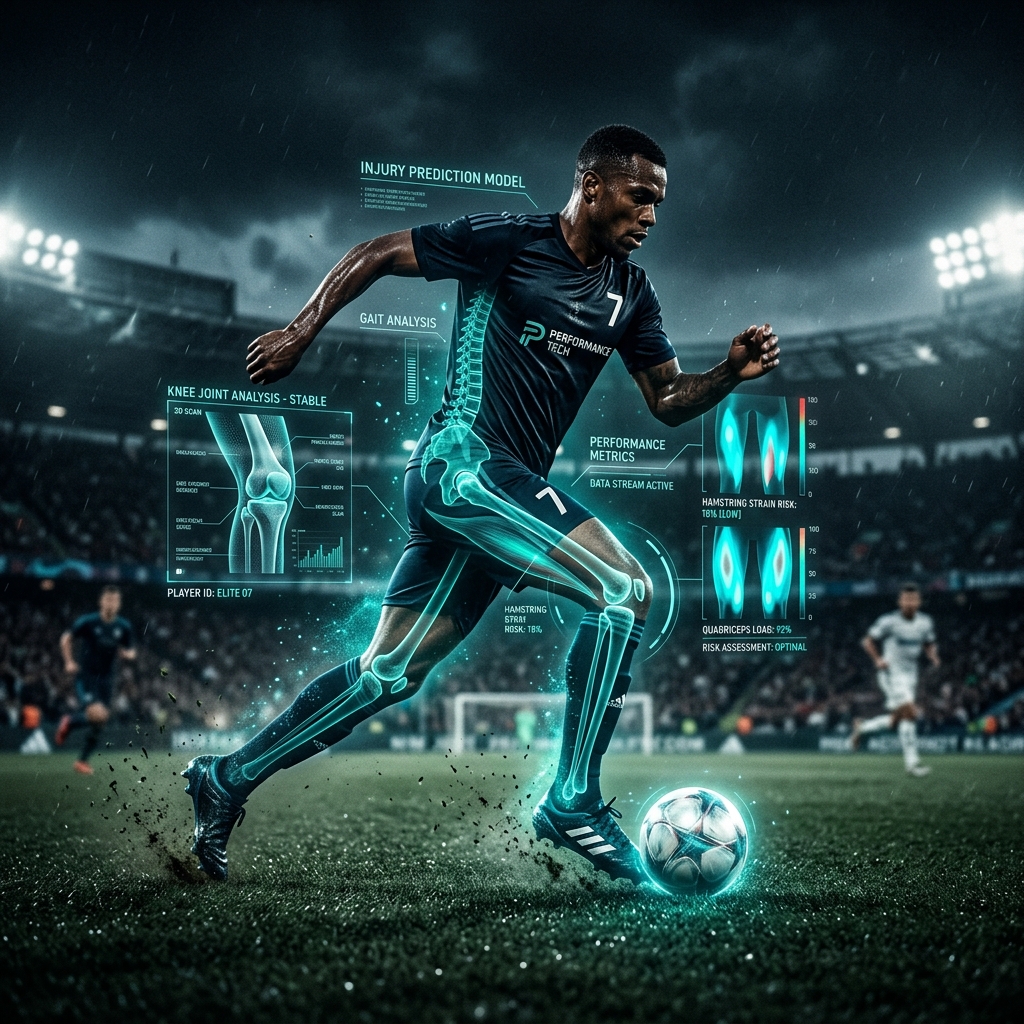
At the intersection of artificial intelligence and high-level sports, the AI that predicts injuries before they happen: a revolution in professional football represents one of the most significant advancements of this decade. From research laboratories to global stadiums, this technological revolution is redefining the boundaries of human performance and opening new perspectives for athletes, coaches, and spectators.
Machine learning algorithms now analyze millions of data points to identify patterns that the human eye could never detect on its own. In the field of football & AI, this silent revolution is transforming how athletes train, recover, and perform in competition.
Computer vision systems, coupled with next-generation biometric sensors, allow real-time monitoring of physiological parameters as precise as blood lactate levels, cumulative neuromuscular load, or cognitive fatigue index. This data, once reserved for sports science laboratories, is now accessible on a smartphone.
Machine learning models, particularly convolutional neural networks (CNNs) and transformer architectures, are revolutionizing tactical analysis. In seconds, a system can ingest an entire match, identify key sequences, and propose precise strategic adjustments based on thousands of analyzed games.
Beyond video analysis, prediction algorithms now make it possible to anticipate injuries before they occur. By cross-referencing training load data, sleep quality, heart rate variability, and salivary biomarkers, these systems generate an individual "risk score" updated daily.
The revolution does not only affect athletes. Fans also benefit from this technological transformation. Broadcasters now integrate augmented reality overlays that display real-time player biometric statistics, scoring probability, or predicted ball trajectories.
Some platforms take the concept even further with "digital twins" — virtual replicas of athletes trained on their historical data, allowing fans to simulate alternative scenarios or access high-level analyses via conversational interfaces based on LLMs.
This intensive digitization raises fundamental questions. The ownership of athletes' biometric data is the subject of intense legal debate: does it belong to the athlete, the club, the equipment manufacturer that collects it, or the leagues that monetize it?
Sports regulatory bodies struggle to adapt their regulations to the speed of technological innovation. The IOC, FIFA, and major North American leagues are working together on a common ethical framework, but diverging interests make consensus difficult to reach.
Artificial intelligence is not a threat to sports — it is its future accelerator. By refining our understanding of human performance, making training smarter, and better protecting athletes, technology allows us to explore frontiers we thought were impassable.
The challenge of the coming years will be to find the balance between technological augmentation and preserving the very essence of sports: the unpredictable beauty of human competition.