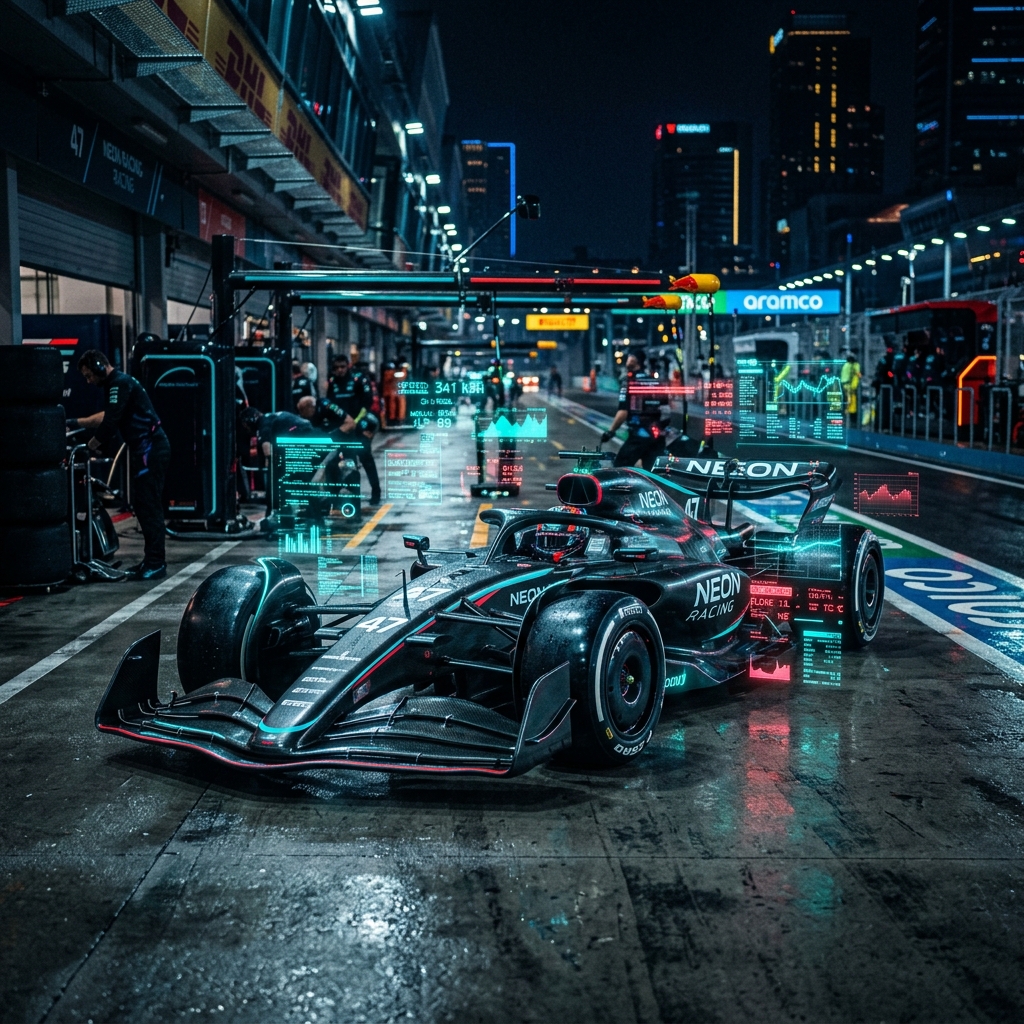
Twenty years ago, winning a Grand Prix was a matter of talent, machinery, and instinct. Today, it is a matter of terabytes, neural networks, and predictive models running at full power while the driver negotiates a turn at 280 km/h. In 2026, Formula 1 has become the most sophisticated artificial intelligence laboratory in the sporting world  and almost no one is fully realizing it yet.
Behind the chrome helmets and carbon fiber bodywork lies a radically new reality: each single-seater generates real-time data streams that three generations of engineers could not analyze manually. Machine learning algorithms are no longer auxiliary tools. They have become the true strategists of the paddock, transforming a century-old discipline into a data sport where bytes matter as much as kilograms.
This subtle but profound shift raises fundamental questions: who really wins a race in 2026? The driver behind the wheel, or the algorithm dictating every decision from the garage bays? NEXUS dove behind the scenes of this new digital Grand Prix.
F1's Statcast: 300 sensors, 500 GB per race
The term "Statcast" was popularized by American MLB to designate its baseball data analysis system. In Formula 1, the equivalent has existed for much longer  and is infinitely denser. A modern single-seater is equipped with more than 300 sensors continuously measuring thousands of variables: tire temperature to the tenth of a degree, aerodynamic load on each surface, fuel flow down to the millisecond, suspension vibrations, and real-time brake degradation.
These data are transmitted in near real-time via telemetry links to the pit walls, then routed to team data centers  often located thousands of kilometers from the circuit. Mercedes operates its Performance Centre in Brackley, Red Bull Racing its Red Bull Technology Campus in Milton Keynes, Ferrari its Maranello center. These digital bunkers run 24/7 throughout the race weekend, driven by teams of data scientists who have never set foot in an F1 garage.

Processing these data volumes has long relied on classical deterministic algorithms  physical models built by aerodynamic engineers. But since 2023, a silent revolution has taken place: machine learning models, particularly recurrent neural networks (LSTMs) and time-series transformers, began supplanting traditional approaches for predicting tire degradation, modeling local weather, and optimizing racing lines. These systems do not code rules  they learn from data of thousands of laps, season after season.
"We no longer look at the data. We listen to it. And since the algorithms whisper their predictions to us, we are winning battles we didn't even know we were fighting." Chief Strategy Engineer, Top 3 team (requested anonymity)
The perfect pit-stop calculated in 0.3 seconds
A pit-stop in Formula 1 today takes between 2.2 and 2.8 seconds for the top teams. But the decision to pit  the "call"  is the most critical moment of the entire race. Making this choice 0.3 seconds too late can cost a position. Making it on a false prediction can cost the entire Grand Prix.
This is where machine learning deploys its full strategic power. Modern AI systems simultaneously integrate a dozen variable streams to calculate the optimal pit window on every lap: predicted tire degradation (by a model trained on hundreds of races and similar weather conditions), track traffic, opponent positions, Safety Car probability (calculated from circuit history and daily conditions), remaining fuel, and projected time gain on the next stint with available tires.

What these algorithms do in 0.3 seconds, a human engineer could not accomplish in 30 minutes. The mathematical cliff is steep: deep learning models can simultaneously explore thousands of race scenarios, weight their probabilities, and recommend a decision with a displayed confidence level. The pit wall receives this result not as a certainty, but as a probability distribution  algorithms don't decide, they guide.
Undercut & Overcut: Real-time simulation
Teams use Monte Carlo simulation models coupled with machine learning to evaluate, lap by lap, the value of each possible pit strategy. On average, a system of this type explores 50,000 different race scenarios per lap, updating its recommendations with every new telemetry data point.
The fully predictive race strategy
Even before the red lights go out on the starting grid, the algorithms have already played their first hand. The night before each Grand Prix, top teams run thousands of predictive simulations integrating weather data from the last 72 hours, precise characteristics of available tires for the weekend (measured grain by grain by Pirelli and shared with teams), asphalt degradation histories circuit by circuit, and behavioral models of opponent drivers  because yes, AIs also learn the driving reflexes of Verstappen, Norris, or Hamilton.
This last point is particularly dizzying: behavioral classification algorithms have been trained to recognize individual driving patterns. How does a particular driver manage tires at the start of a stint? How hard do they attack slow corners under a Safety Car? What is their usual response to an undercut threat? These digital signatures make it possible to predict opponent behaviors with increasing precision, turning race strategy into a game of chess played at 300 km/h.
"The race is now won in servers before the mechanics have even finished warming up the tires. What you see on the track is the execution of a score written by machines." Ross Brawn, former F1 Managing Director, Motorsport Magazine, March 2026
Weather is another algorithmic battleground. Teams no longer settle for official weather reports: they deploy their own networks of hyper-localized barometric sensors around the circuit, coupled with deep learning-based forecasting models. These systems, inspired by NWP (Numerical Weather Prediction) models used by national agencies, can detect local rain risk with an 8 to 12-minute forecast window  exactly the time for a full lap. This information advantage can transform a tire strategy and give a team a decisive lead.
Red Bull vs Mercedes: The algorithm war
While Formula 1 has always been an engineering competition, the data era has opened a new invisible front: the algorithm war. And the two empires fighting over this terrain are no longer just those of aerodynamics and mechanics  they are those of data science and computing infrastructure.
Proprietary Model "APEX-AI"
Platform "SilverStream Analytics"
Red Bull Racing, which has dominated the discipline for several seasons now, relies on an algorithmic infrastructure built in partnership with Oracle. Their proprietary system, internally codenamed "APEX-AI" according to paddock sources, centralizes all telemetry streams in a dedicated cloud, allowing real-time collaboration between trackside engineers and those back in the UK. The key model is a deep neural network specialized in predicting Pirelli tire degradation, trained on seven seasons of data  tens of millions of measurement points.
Mercedes, for its part, is not far behind. The German team has heavily invested in what it internally calls its "SilverStream Analytics" platform, a suite of machine learning tools covering aerodynamic optimization via numerical simulation (AI-boosted CFD), race strategy planning, and even biomechanical analysis of the driver to detect real-time fatigue from physiological data transmitted by the bucket seat. This latter innovation, introduced in 2025, allows the team to know if its driver is at risk of making mistakes in the final 10 laps  and adapt its radio communication accordingly.
Ferrari & the Reinforcement Learning Revolution
Since 2025, Ferrari has been experimenting with reinforcement learning  the same family of algorithms that allowed AlphaGo to beat world Go champions  to optimize racing lines in simulation. The AI plays against itself millions of times, discovering racing lines that human engineers would never have considered. Some of these trajectories have since been integrated into driver briefings.
Conclusion: The human, mere executor?
The question is uncomfortable, but it imposes itself with growing urgency as seasons pass. Is the Formula 1 driver in 2026 still the hero of the story, or have they become the final link in a decision chain dominated by machines?
The honest answer is: neither. Drivers remain absolute elite athletes, capable of cognitive and physical performances that machines cannot reproduce  reacting to the unexpected in a split second, feeling a warm tire's limit of grip, negotiating a corner in the rain with intuition shaped by years of practice. But their role has profoundly evolved: they have become executors of an increasingly prescribed strategy, the interfaces between algorithmic decision and the physical reality of the track.
What resists the algorithm is precisely what makes the beauty of the sport: the accident, the surprise, the moment of grace or error that overturns a prediction. Algorithmic Formula 1 is not a dystopia  it is an evolution, fascinating and dizzying, redefining what it means to win. And in this new grammar of competition, the human challenge does not disappear: it moves. It migrates from the steering wheel to the server, from the cockpit to the algorithm room, from adrenaline to neural architecture.
One thing is certain: those who understand this transformation the fastest  teams, drivers, sponsors, fans  will be those with a head start in the most complex race motorsport has ever contested. The start has already been given. The lights are out. And somewhere in a Milton Keynes data center, an algorithm is smiling.


