Refereeing 2.0: How Automated VAR and Real-Time AI are Making the Whistle Obsolete

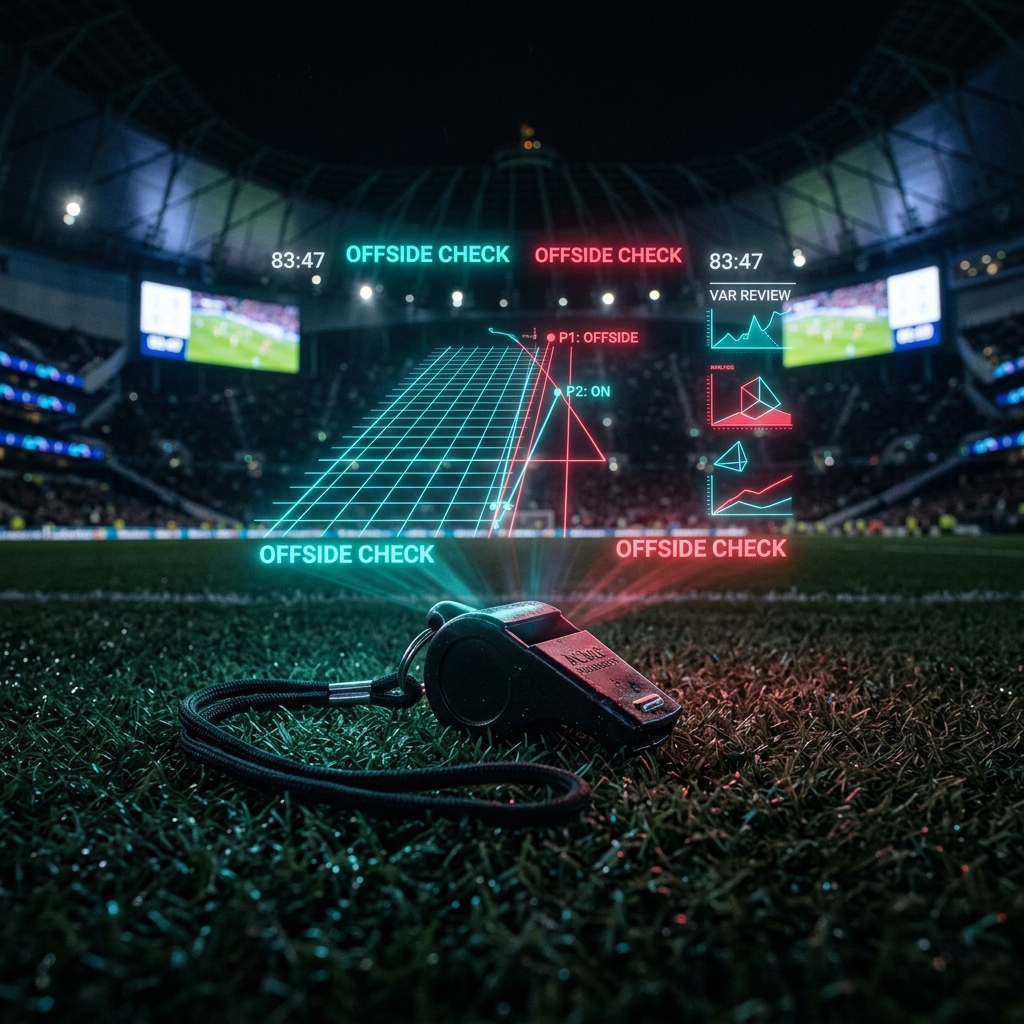
It was a freezing winter night in 2022. The World Cup in Qatar was in full swing. A ball seemed to cross the goal line during a highly tense match, and suddenly, silence fell over the stadium. A few seconds later, a computer-generated image appeared on the giant screens, validating the goal down to the millimeter. On that day, refereeing entered a new dimension. Today, in 2026, the question is no longer whether the machine will assist humans, but whether it will definitively replace them.
The whistle, this iconic object of sports authority for over a century, is becoming an artifact of the past. Driven by the billions of dollars generated by television rights and sports betting, the tolerance for human error on a field has reached a level close to absolute zero. Major leagues are investing heavily in computer vision systems, artificial intelligence, and embedded sensors capable of analyzing action with surgical precision, and above all, in real time.
In this NEXUS investigation, we dive into the bowels of this silent revolution, where arbitral judgment is transformed into a series of algorithms and biometric data.
The Era of Ultra-Precision: The End of Human Disputes?
The advent of VAR (Video Assistant Referee) was often criticized for its slowness, its endless stoppages of play, and its inability to erase controversies. The problem did not come from the video itself, but from the human interface that interpreted it. This is where Artificial Intelligence steps in to offer Refereeing 2.0: Semi-Automated Offside Technology (SAOT) and next-generation Goal-Line Technology.
Today, modern stadiums are equipped with an armada of ultra-high-speed optical cameras (up to 12 to 15 cameras) strategically distributed under the roofs. These cameras capture the movements of the players by tracking up to 29 body points per athlete, 50 times per second. The slightest deviation, the slightest bit of foot or shoulder protruding past the defender's line is instantly detected and modeled in 3D.

The beauty – or the terror, depending on your point of view – of this technology is its cold objectivity. The AI does not feel the pressure of 80,000 screaming fans. It is not influenced by the reputation of a star player. It applies the rule mathematically. During the last Champions League season, the average time to check an offside went from 70 seconds with the old VAR to less than 5 seconds with AI systems, sending the decision almost instantly into the earpiece of the field referee.
The Technology Under the Hood: Computer Vision and Integrated Chips
But how exactly does it work? The magic happens thanks to the fusion of two data streams: optical and kinematic.
At the heart of the ball itself lies an engineering marvel: an IMU (Inertial Measurement Unit) sensor suspended in the center of the sphere by an ingenious tension system. This chip transmits positioning and movement data at a dizzying frequency of 500 times per second (500 Hz). It allows the system to determine with minute precision the "kick point" (the exact moment the ball is struck), crucial data for offside analysis.
On the software side, convolutional neural networks (CNNs) process terabytes of video in real time. They not only identify the players, but also analyze their skeletons and posture. Companies like Hawk-Eye Innovations and Kinexon are redefining the state of the art of Machine Learning applied to sports.
Deep learning algorithms are trained on millions of archive sequences. They are now capable of distinguishing an intentional handball from a hand glued to the body, by analyzing the speed of the ball, the distance, and the natural or artificial movement of the defender's arm. Of course, "intent" remains a complex human concept, but the machine provides probabilities with unsettling precision.
The Impact on the Game: Fluidity vs. Spontaneity
While the promise of total fairness is appealing, the implementation of automated refereeing raises passionate debates about the very soul of sport. Football, rugby, or tennis draw their dramatic strength from the uncertainty and instant emotional explosion that accompanies a goal, a try, or a decisive point.
The hypercentralization of decisions towards algorithms creates a new dynamic: the sterile wait. Although AI has sped up the process compared to the early days of VAR, doubt still lingers in the spectator's mind during those handful of seconds while the machine calculates. Can we still celebrate the moment the ball crosses the line, or must we wait for validation from the central computer server?
However, the defenders of Refereeing 2.0 argue that the fluidity of the game is enhanced. The automation of "binary" decisions (offsides, line crossings) allows the human referee to focus exclusively on judgment calls, dangerous actions, and managing psychological tension on the field.
What Future for the Human Referee?
Faced with the growing omniscience of artificial intelligence, what role remains for the flesh-and-blood referee? The answer is not disappearance, but mutation.

The referee of tomorrow will be more akin to a "system operator" or a human mediator on the field. While the AI dictates indisputable technical decisions via augmented reality glasses or haptic earpieces, the human will be in charge of applying the sanction and explaining the choices to the players. Pedagogy, empathy, and conflict management, purely human traits, will remain indispensable to prevent a match from degenerating under the frustration that a sanction perceived as a cold decision from a machine can generate.
Leagues are already experimenting with autonomous camera drones following the action and "robot assistants" along the touchlines. The whistle may not disappear completely, but it will no longer be the absolute tool of decision; it will become the voice of an algorithmic consensus.
Conclusion
The invasion of artificial intelligence and computer vision in the world of refereeing is inevitable. By promising to erase the injustice inherent in human subjectivity, technology redefines the pact of trust between the sport, its actors, and its public. If football, tennis, and many other disciplines must lose an ounce of spontaneity, they gain formidable fairness.
Refereeing 2.0 is here, silent, precise, relentless. It observes every angle, captures every acceleration, and never blinks. Welcome to the era where the sports field becomes the largest data laboratory in the world, and where AI now has the final word.


