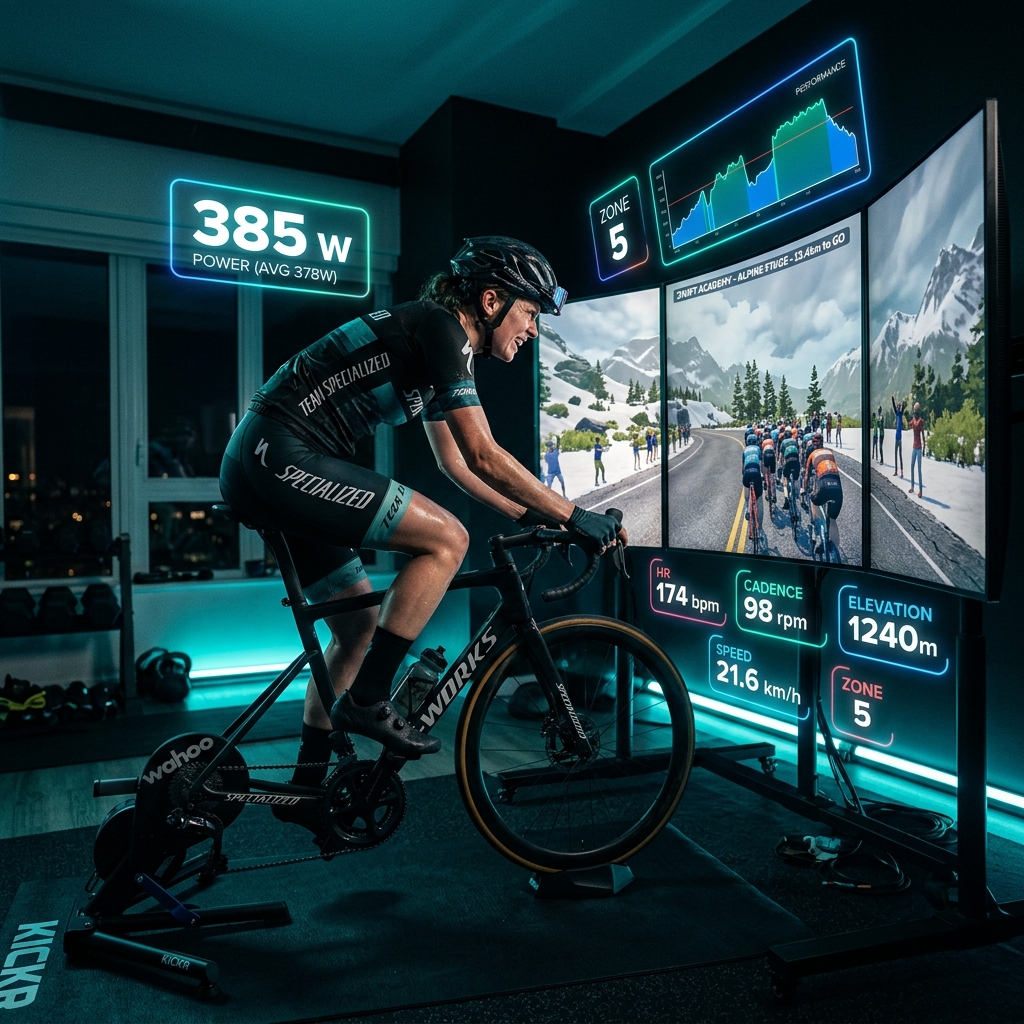

Sweat beads on the forehead, the heart rate spikes beyond 170 beats per minute, and thigh muscles burn with an intensity familiar to any climber, recalling the worst moments of failing in high mountains. Yet, the cyclist is not climbing the steep, rocky slopes of Mont Ventoux or the mythical turns of Alpe d'Huez. He is in his living room, confined between a sofa and a coffee table, eyes glued to a 4K screen, pedaling frantically on a smart trainer. Welcome to the era of high-level virtual cycling, where physical pain is no longer dictated by natural topography, but by complex mathematical algorithms and an artificial intelligence that leaves absolutely no room for improvisation or cheating.
Since its explosive rise in the early 2020s, initially stimulated by successive global lockdowns, cycling e-sport has radically mutated. With tech giants like Zwift, MyWhoosh, or Rouvy, the discipline has transcended the status of a mere arcade video game to become a true physiological test, endorsed by the International Cycling Union (UCI). But how does a digital interface, composed of pixels and polygons, manage to simulate so convincingly and brutally the harshness of the real world? The answer lies in the intimate fusion of human biomechanics, ultra-precise power sensors measuring effort to the millisecond, and a physics engine of formidable efficiency that recalculates in real-time the immutable laws of gravity and aerodynamics.
The Physics Engine: Decrypting the Equation of Suffering
At the absolute core of the virtual cycling experience lies a fundamental equation that governs the movement of your avatar in the digital space. The software must constantly resolve the relationship between the mechanical power generated by the rider (measured in watts directly at the crankset or rear cassette) and the resistance opposed by the simulated environment. This total resistance, which determines your forward speed, is the sum of three main forces: rolling resistance (the virtual friction of tires on the asphalt), the force of gravity (intimately linked to the gradient of the slope), and aerodynamic drag, by far the most complex to calculate.
When you start a virtual climb displaying a 10% gradient, the software kicks into higher gear. It analyzes your exact body weight (a crucial piece of data for calculating the famous power-to-weight ratio, expressed in Watts/kg), the topographical steepness of the virtual terrain, and your instantaneous power. In a fraction of a second, the algorithm generates a packet of data and sends, via ANT+ or Bluetooth Low Energy wireless protocols, an electromagnetic resistance command to your smart trainer. The latter, equipped with a heavy flywheel weighing several kilograms and powerful electromagnetic brakes, literally tightens the screws. Suddenly, every pedal stroke becomes a real muscular ordeal, reproducing with troubling fidelity the force of Earth's gravity fighting against your own body mass on the slopes of the Galibier.

The source code: the invisible architect of physical effort and the laws of dynamics.
But the true technological feat of these platforms lies not only in the brutal simulation of the slope. It is particularly illustrated in the continuous calculation of air resistance. On the flat, at over 30 km/h, aerodynamic drag represents up to 80% of the total resistance to overcome. The physics engine integrates incredibly fine dynamic variables: the size of the rider, the virtual position of the avatar on the bike (hands on the hoods to breathe, or in the drops during a devastating sprint), and even the type of virtual equipment used (an aero frame or high-profile carbon wheels modify the drag coefficient, the CdA, of the avatar).
AI and Peloton Dynamics: The Complex Science of Drafting
Where Artificial Intelligence truly enters the scene and demonstrates its supremacy is in the chaotic management of pelotons and the slipstream effect, globally known as "drafting". In real cycling, skillfully positioning oneself on the wheel of an opponent allows saving up to 30% of energy, by sheltering in the low-pressure zone created by the cyclist ahead. Modeling this phenomenon in real-time, for thousands of riders evolving simultaneously on the same network server, is a computing puzzle and a feat of distributed processing.
The AI of next-generation platforms uses neural networks to anticipate, calculate, and model the turbulence zones and drafting cones generated by each moving avatar. The algorithm continuously evaluates at what millimeter distance you are from the rider ahead of you, the angle of your position (are you perfectly aligned behind him or slightly offset, thus experiencing virtual crosswinds?), and the relative speed of both riders. If the system validates that you are "in the draft", it instantly reduces the overall algorithmic resistance imposed on your avatar. Result: you ride faster at the same power, exactly as on the road. It is a dance of data where fluid physics is translated into lines of code.
However, the density of a competitive virtual peloton, which can count hundreds of avatars clumped together in a tight space riding at over 45 km/h, poses colossal challenges in terms of network latency. To prevent avatars from teleporting, overlapping chaotically, or reacting with a delay (the famous destructive "lag" in e-sport), engineers deploy "dead reckoning" algorithms. These predictive mathematical models calculate the probable trajectory of the riders between two data packets sent to the central server. They ensure a stunning visual fluidity and physical integrity, giving the perfect illusion of an organic race where millimeter placement becomes a vital strategy.

Data serving absolute performance: direct-drive smart trainer and real-time monitoring screen.
Digital Doping: The Endless War Against Algorithmic Cheating
The rapid emergence of official competitions under the aegis of the International Cycling Union (UCI) has caused financial stakes to rise exponentially. With significant prize money, sponsorship contracts, and professional teams 100% dedicated to e-sport, virtual cycling has inevitably attracted a new kind of cheater. Here, no EPO, steroids, or dubious blood transfusions in hotel rooms. Doping has become purely digital. It primarily takes the form of "weight doping" (declaring a lower weight in the game settings to artificially increase one's power-to-weight ratio in the mountains) or, more seriously, hardware hacking of ANT+ protocols to "inject" fake watts into the system without real effort.
To counter this new form of sports cybercrime that threatens the very integrity of the discipline, developers have had to transform into digital anti-doping agencies, implementing incredibly complex verification systems. The ZADA (Zwift Accuracy and Data Analysis) structure acts as an uncompromising enforcer. It relies heavily on machine learning to continuously and retrospectively analyze the power curves of thousands of competitors. The AI has been trained on millions of physiological profiles from professional and amateur cyclists worldwide.
If the algorithm detects a suspicious variation — for example, sudden anaerobic power production that defies known human physiological limits for the athlete's declared weight —, the system triggers a red alert. The rider is then discreetly "shadowbanned" or publicly asked to provide tangible proof of their capabilities. In some high-profile cases, e-athletes have had to go to independent certified laboratories, under the watchful eye of cameras, to replicate exactly the watts produced in the game. The algorithm doesn't lie, and those who attempt to manipulate it face lifetime bans from all official competitions.
The Future: Towards Neural, Sensory, and Climatic Symbiosis?
While the accuracy of current algorithms is already mind-blowing, the technological arms race doesn't stop there. The Research & Development departments of Sport Tech giants are actively working on the next generation of cycling e-sport. The ultimate goal? To bridge the final gap separating virtual suffering from the physical world experience: hyper-realistic haptic feedback and the integration of procedurally generated dynamic weather variables.
Highly advanced prototypes of motorized "dynamic platforms", on which the entire bike is placed, are already synchronized in real-time with the game's physics engine. These plates not only simulate the physical tilt upwards or downwards, but faithfully reproduce the microscopic and specific vibrations of the virtual surface type (the terrible cobblestones of Paris-Roubaix, the shifting resistance of gravel, or the smooth rolling of fresh asphalt). Furthermore, the imminent integration of ultra-light virtual reality (VR) headsets, coupled with "smart fans" whose power and air temperature are dynamically regulated by the avatar's virtual speed and altitude, promise total multisensory immersion.
Ultimately, the algorithm of pain is much more than a simple feat of mathematical coding. It is the fascinating bridge between our visceral biological effort, our sweat, and a relentless digital world that quantifies it, sublimates it, and instantly shares it with the entire planet. When you suffer martyrdom on the final ramps of the Alpe du Zwift, averaging over 10%, remember that this pain is the fruit of a perfect equation, executed and validated millions of times per second. The computer, meanwhile, feels no pain, but it has learned, with chilling precision and absolute scientific rigor, how to make you feel it deep within your muscle fibers.