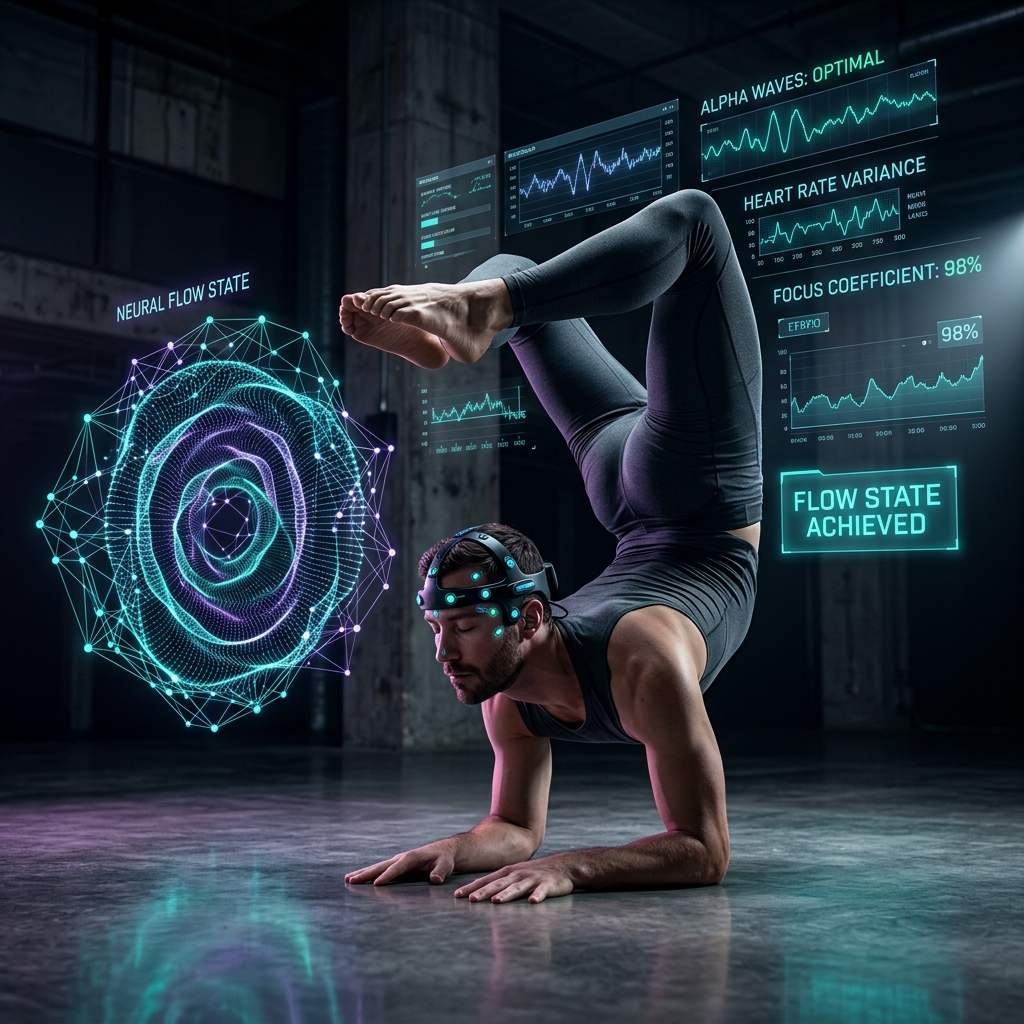

Forget for a moment the incense, Tibetan bowls, and the simple injunction to "let go." In the most avant-garde yoga studios from Silicon Valley to the futuristic dojos of Tokyo, the quest for inner peace has taken a decidedly cybernetic turn. Today, to achieve the elusive "flow state," athletes of the mind no longer rely solely on their intuition. They use electroencephalography (EEG) headsets paired with ultra-powerful artificial intelligence.
The fusion of the millennia-old tradition of yoga and modern neuroscience gives rise to a new discipline: quantified meditation. By measuring the electrical activity of the brain in real-time, this technology promises to transform a subjective learning process into a precise science. But how exactly does this neural biofeedback work, and can it really "hack" our way to enlightenment? The NEXUS team investigated, probes on our skulls and connected mats under our feet.
The Brain on Listen: Understanding EEG and Biofeedback
To understand this revolution, we must first dive into the workings of our brain. Our neurons communicate via electrical impulses, generating measurable brain waves. When practicing yoga or meditation, the neurobiological goal is often to slow down these waves: moving from Beta waves (state of wakefulness, stress, and alertness) to Alpha waves (light relaxation, visualization), and then to Theta waves (deep meditation, creativity, intuition).
Historically, the electroencephalogram (EEG) was a heavy and intimidating medical machine, reserved for clinics. Today, sleek, wireless headbands capture these signals with remarkable precision. This is where the fundamental concept of biofeedback comes in. The principle is simple: to make an unconscious physiological process perceptible in order to learn how to control it.
Imagine you are in the Lotus pose. Your thoughts wander to your grocery list or that unsent work email. Immediately, your Beta waves spike. Your EEG headset detects this stress peak. In a few milliseconds, it transmits the data to your smartphone. The application, instead of reprimanding you, modifies the sound environment: you hear the sound of a rising storm. You become aware of your distraction, you bring your attention back to your breath. The storm calms down, giving way to the song of birds. This is biofeedback in action.
"We are not replacing the yoga teacher. We give the student a mirror of their own mind. AI makes it possible to see the invisible and correct cognitive biases in real-time."
AI as a Digital Spiritual Guide
If the EEG is the microphone, artificial intelligence is the sound engineer. The raw data from the brain is extremely chaotic: millions of microvolts polluted by eye blinks or muscle contractions. Machine learning algorithms are essential to clean up this signal (artifact rejection) and extract the true cognitive signature.

AI goes much further than a simple reading. By analyzing your past sessions, predictive neural networks can model your learning curve. The algorithm learns to precisely identify the neuro-electrical signature of YOUR personal flow state. Because the state of grace is not the same for everyone. The AI dynamically adapts the difficulty of the feedback to keep you in the "zone of proximal development": a mental challenge neither too easy (which would cause boredom) nor too difficult (which would cause anxiety).
Generative AI models are now capable of composing music in real-time, specifically tailored to induce particular brain frequencies via the phenomenon of brainwave entrainment. The tempo, binaural frequencies, and harmonies adjust to literally "guide" your brain towards the Theta frequency.
State-of-the-art Hardware: Towards an Augmented Practice
The hardware ecosystem that supports this software revolution is diversifying. Sensors are no longer limited to the head. We are seeing the emergence of "smart mats" equipped with thousands of piezoelectric pressure sensors. Paired with EEG, they allow AI to establish a direct correlation between the biomechanical perfection of a posture (Asana) and the practitioner's cognitive state.
A practitioner equipped with a Muse or Flowtime headband, a heart rate variability (HRV) monitor, and a connected mat generates about 1 GB of data per hour of practice. These gigabytes are the fuel that allows the algorithm to optimize future sessions.
Limits and Ethics of Quantified Meditation
Despite the enthusiasm, tech-yoga raises fundamental questions. Isn't excessive quantification the very antithesis of yoga philosophy? Patanjali's yoga aims at liberation (Moksha) through detachment from the ego. However, frantically scrutinizing meditative performance graphs on one's iPhone after a session can instead exacerbate the ego, creating a form of "spiritual competition."
Furthermore, the issue of neural data privacy (neuro-privacy) is critical. The electrical activity of your brain is the most intimate biometric data there is. It can reveal chronic stress states, predispositions to depression, or emotional triggers. The protection of this data by the companies developing these AIs must be framed by legislation as strict as medical secrecy.
"The major risk is not that AI replaces spirituality, but that it transforms it into a mere productivity tool for stressed employees."
Awakening 2.0: A Hybrid Future
Ultimately, EEG and AI are not magic pills that will do the spiritual work for you. The flow state still requires commitment, discipline, and sweat (on the mat). However, these technologies act as powerful catalysts. They demystify practices that have long remained esoteric and offer a tangible gateway to those who struggle to tame mental silence.
The future of yoga will probably be neither a puritanical rejection of technology, nor a total submission to algorithms. It will lie in a cyborg balance: using the clinical precision of AI and EEG to teach us to walk, until the day we can run on our own wings, disconnected, right in the heart of the flow state.


