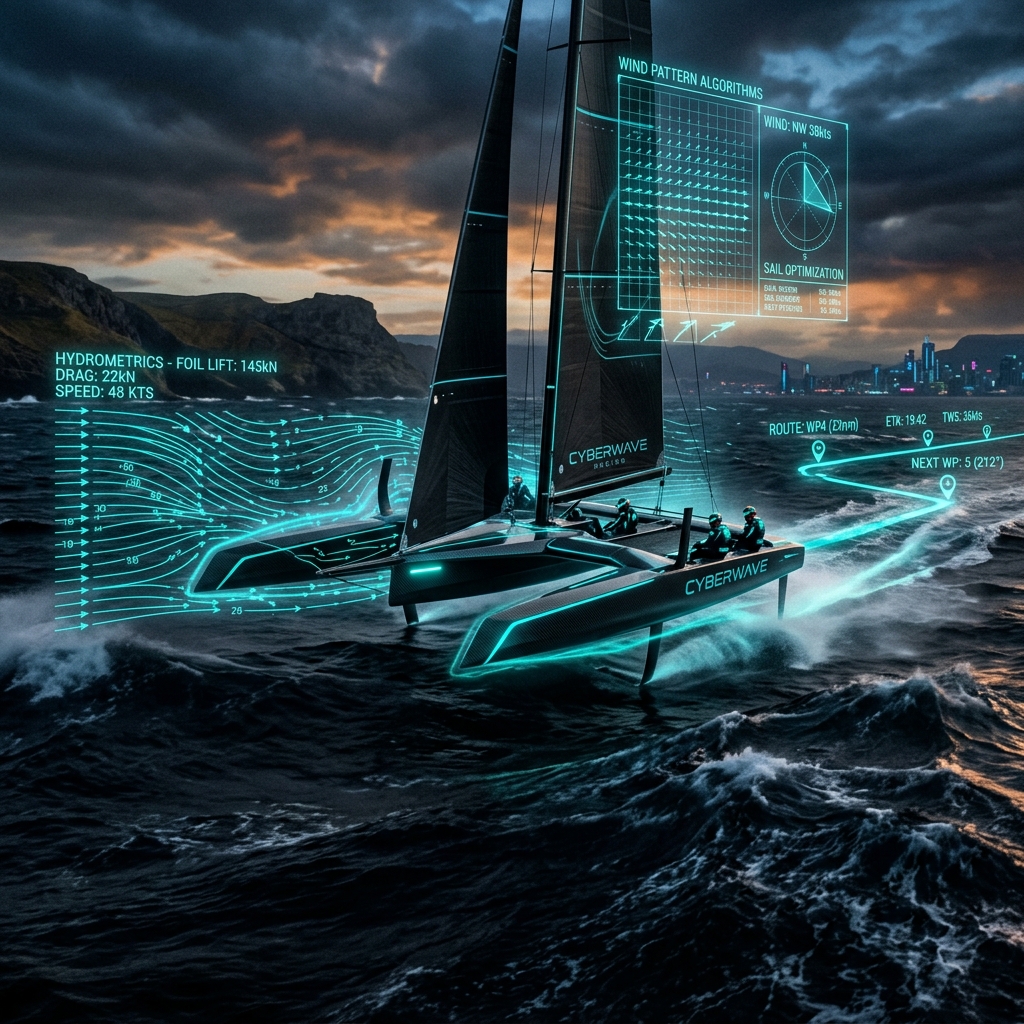
The America's Cup has always been the pinnacle of naval technology. But this year's edition marks a fundamental break: it's no longer just a race for sailors or aerospace engineers, it has become the greatest algorithmic battle ever fought on the water. With the advent of quantum routing and artificial intelligence-powered hydrodynamic optimization, the ocean has been digitized, decoded, and conquered.
In the harbor, the digital silence is deafening. Dozens of servers run at full capacity inside the operations bases of the America's Cup syndicates. The AC75 monohulls, these flying monsters capable of reaching 50 knots (over 90 km/h) by relying on tiny foils, are now ultra-connected IoT nodes. They generate up to 150 gigabytes of data per hour of sailing. But having data is no longer enough. Today, the trophy is won on the ability to process these oceanic flows in a fraction of a second. Welcome to the era of quantum routing.
Quantum Routing: Anticipating Wind Chaos
Marine weather is, by definition, a chaotic system. Until recently, tacticians relied on classic meteorological models (GRIB) updated every few hours. Today, leading teams have shifted into an entirely new computational paradigm, leveraging quantum-inspired algorithms running on massive computing farms (HPC).
These systems no longer just predict the wind linearly. They calculate thousands of simultaneous probabilities in real-time, integrating water temperature, micro-currents, coastal topography, and even the turbulence generated by the wake of spectator vessels. The routing AI analyzes these myriads of scenarios and plots the perfect "layline": a mathematically optimal trajectory that adapts second by second.
"We are no longer sailing on water. We are sailing on a mathematical mesh of fluid probabilities."
One of the lead engineers of a European team, speaking on condition of anonymity, confided to us that their system uses graph neural networks (GNN) to model the water surface as a dynamic graph. Each node in the graph represents a 2-square-meter plot of water, and the edges define the vectors of wind and current. The advantage of such precision? Being able to "see" a gust (a localized blast of wind) form even before it hits the water, simply by analyzing pressure gradients invisible to the naked eye.

Operations bases now look more like aerospace control centers than boathouses.
Real-Time Hydrodynamic Optimization
While macroscopic strategy is handled by quantum routing, the microscopic management of the boat relies on real-time hydrodynamic optimization. The AC75s don't float, they fly. The entire hull is out of the water, and the precarious balance of these 6-ton machines is maintained by the foils, the rudder, and the sails.
This is where Reinforcement Learning comes in. For months, virtual agents have sailed perfect digital replicas of the boats (Digital Twins) in hyper-realistic simulators. Through millions of trial-and-error iterations, these AIs learned the optimal settings for every millimeter of foil deployment across hundreds of thousands of combinations of wind and chop.
Today, on the water, the "Flight Controllers" (the human flight trimmers) are assisted by HUDs (Head-Up Displays) integrated into their smart glasses. The hydrodynamic AI analyzes the boat's attitude (pitch, roll, yaw) at 1000 Hz via gyroscopes and fiber-optic sensors embedded in the carbon of the foils. Even before the boat starts to nosedive from an unexpected wave, the system instantly recommends the ideal angle of attack (rake) correction to the flight controller, down to a tenth of a degree.
The End of the Human Tactician?
Faced with this algorithmic tidal wave, a philosophical and sporting question arises: has the human become obsolete in the America's Cup? The answer, paradoxically, is no. Artificial intelligence, despite all its computing power, excels in clear deterministic or probabilistic environments. But fleet racing or match racing involves a fundamental factor: the opponent.
"The algorithm can calculate the fastest trajectory, but only the human can decide on the most aggressive trajectory."
The AI might tell you that tacking now will save you 2 seconds on a pure leg. But the human tactician knows that delaying this tack by 5 seconds will force the opponent to sail in your boat's "dirty air" (wind shadow), causing them to lose 10 seconds. It is the symbiosis, the hybridization between the pure computing power of the machine and the social, aggressive, and Machiavellian intelligence of the human racer that wins the Cup today.

The synchronization between the physical crew and the onboard AI must be absolute.
The Hardware: From Sensors to Edge Computing
For these complex models to work without latency, back-and-forth communication with the Cloud is impossible. Edge Computing takes over. Hidden beneath the carbon deck of the AC75s are compact supercomputers, seawater-cooled, equipped with neuromorphic chips and tensor accelerators. They process data from hundreds of sensors: lidars scanning the water surface 50 meters ahead of the bow, thermal cameras reading the temperature of the sails to deduce tension, and directional microphones capturing the structural creaks of the mast.
Every maneuver is post-analyzed the same evening. The data is ingested into the digital twins, and the Machine Learning models are retrained overnight. The next morning, the crew boards with updated software, slightly smarter, slightly faster than the day before.
It is a perpetual, silent, and invisible arms race. The America's Cup has always been the R&D laboratory of world sailing. Today, it is becoming a fascinating testbed for artificial intelligence applied to complex fluid dynamics in real time.
Conclusion: As the AC75s launch at speeds unthinkable ten years ago, propelled by the wind but driven by data, we are witnessing the dawn of a new era. Quantum routing and hydrodynamic AI do not distort the sport; they elevate human expectation. The sea remains wild, but sailors now have the eyes of mathematical gods to tame it.

