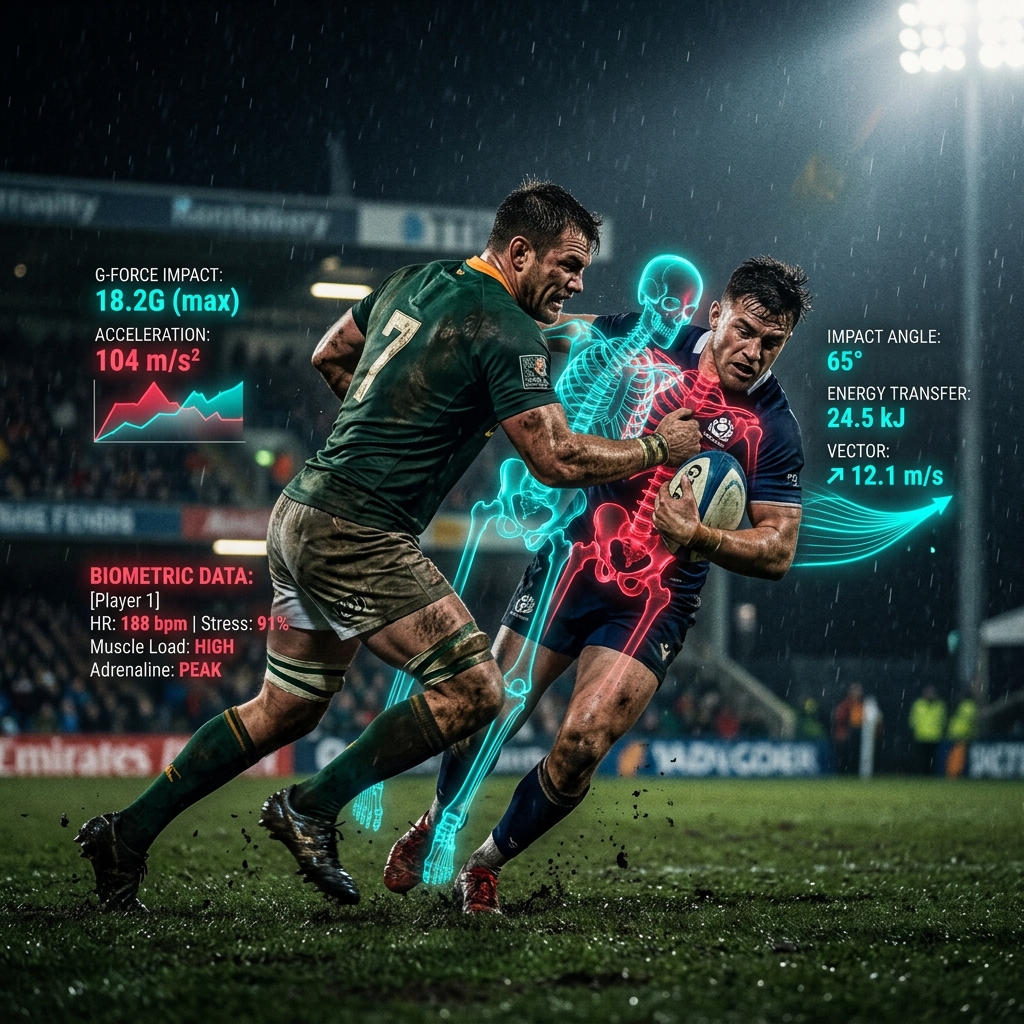
Rugby has long been perceived as the ultimate combat sport, a discipline where brute force, physical density, and courage prevail over scientific finesse. However, behind the devastating impacts and the mud of the rucks hides one of the most advanced technological laboratories in the sports world today. In the era of artificial intelligence and Big Data, every tackle, every run, and every scrum is scrutinized, quantified, and optimized. At NEXUS, we investigated this silent revolution that is redefining rugby: how does AI help safeguard player health against the scourge of concussions, while providing coaching staffs with tactical weapons of surgical precision?
Smart Sensors Against the Scourge of Concussions
This is undoubtedly the most existential challenge facing modern rugby: the management of traumatic brain injuries. With the proliferation of lawsuits from former players suffering from chronic traumatic encephalopathy (CTE), governing bodies, led by World Rugby, had to react. The solution came from the miniaturization of sensors and machine learning algorithms.
Today, a professional player's standard equipment includes an element invisible from the stands: the connected mouthguard. Designed by biomedical companies in partnership with tech firms, this engineering marvel features triaxial accelerometers and gyroscopes capable of measuring the G-forces experienced by the skull during an impact. But the real revolution does not lie in simply collecting data; it lies in its real-time processing by Artificial Intelligence.

The algorithms filter out 'false positives' (such as a player shouting or throwing their mouthguard) to focus on the actual biomechanical signatures of the impacts. When a tackle generates linear or rotational acceleration exceeding a critical threshold, an alert is instantly sent to the match doctor's tablet. The system also cross-references this data with predictive models: the AI assesses the probability that a concussion has occurred based on the impact vector, thereby obliging the player to undergo an HIA (Head Injury Assessment) protocol even before the first clinical symptoms appear.
The Scrum Under the Scanner of Artificial Intelligence
While injury prevention is vital, the pursuit of performance remains the driving force for technical staffs. One of the most emblematic and complex phases of play in rugby is the scrum. Historically considered a 'dark art' governed by the cunning of the props and the subjectivity of the referee, the scrum is now mathematically modeled.
Forward packs today train on scrum machines equipped with dynamometric force plates. Each player wears a GPS vest equipped with biomechanical sensors. The goal? To perfectly align the thrust vectors. AI intervenes here by analyzing the synchronized data streams to model the virtual 'spine' of the pack.
A deep learning model analyzes thousands of scrum configurations to determine the ideal angle of entry, the optimal mass distribution (which should not be symmetrical, contrary to popular belief, but adapted to the opponent's morphology), and the synchronization of the impact (the famous 'crouch, bind, set'). During video sessions, AI is capable, via computer vision, of superimposing force lines on real images to show players the kinetic energy leaks. A prop mispositioned by a few degrees can cause a loss of up to 15% of the pack's overall power. Thanks to this data-driven approach, the scrum becomes an exact science.

Injury Prediction and Workload Management
An international rugby player runs an average of 6 to 8 kilometers per match, but it is the high-intensity runs and impacts that degrade the body. GPS trackers, like those provided by Catapult Sports or STATSports, measure distance and speed, but also sudden accelerations and decelerations.
This is where sports data scientists come into play. Using Random Forest algorithms or neural networks, clubs create 'biological fatigue passports' for each athlete. The system digests training data, playing time, sleep cycles, heart rate variability (HRV), and even subjective wellness questionnaires filled out by the players each morning.
If the AI detects an emerging running asymmetry in a winger (often an early warning sign of a hamstring injury) or too high a cumulative impact volume for a back-rower, it generates a red alert. The fitness coach then receives an AI-generated recommendation suggesting a 30% reduction in the intensity of the next session for that specific player. This surgical management has allowed many teams to reduce their muscle injury rates by more than 25% over an entire season.
Sporting Fairness in the Face of Big Data: Augmented Video Refereeing
Finally, data is entering into refereeing decision-making. The introduction of the connected ball (Smart Ball), the result of a partnership between the historic equipment manufacturer Gilbert and the startup Sportable, is a major turning point. This ball embeds an RFID chip communicating with beacons placed around the stadium at a frequency of 20 times per second.
This system offers absolute 3D tracking. The AI can now instantly signal if a pass was forward (by calculating the player's velocity and the ball's inertia at the moment of release), if a lineout throw was not straight, or measure the hang time of a kick. For the Television Match Official (TMO), this is an invaluable aid. Computer vision models are even being developed to automatically detect offsides in rucks, a human task almost impossible to perform at real speed with precision.
Conclusion
The integration of Artificial Intelligence in rugby does not alter this sport of values; it makes it evolve towards a safer, fairer, and technically more accomplished practice. From the neural protection offered by connected mouthguards to the biomechanical optimization of scrums, data is establishing itself as the sixteenth man on the pitch.
As the 2027 World Cup looms, the nations that will dominate world rugby will no longer just be those with the densest or fastest athletes, but those whose software architecture best translates terabytes of data into real competitive advantages. The rugby of tomorrow is already here, and it is written in lines of code.