The hidden geometry of the hoop
There is something almost mystical about shooting in basketball. That fraction of a second when the ball leaves the fingers, rises in a perfect arc, and tears through the net with that sharp, definitive sound that purists call the swish. To the spectator, it is a gesture of pure grace, almost magical. To an artificial intelligence algorithm, it is a biomechanical equation with hundreds of variables — and this is precisely where the silent revolution that is reshaping professional basketball from its foundations is taking place.
Since the late 2010s, NBA franchises have heavily invested in AI-assisted motion analysis systems. The goal? To decompose, analyze, and correct every aspect of the shooting motion with a precision that no human coach, no matter how experienced, could achieve with the naked eye. Elbow angle, release point height, ball rotation, arc trajectory, synchronization of knees and hips... every detail is captured, measured, compared to thousands of historical data points, and returned in near real-time as actionable recommendations.
This is no longer science fiction. It is the daily routine of teams in the most followed league in the world. And what these machines reveal about the perfect shot is as fascinating as it is counterintuitive.
Noah Basketball and the shot analytics revolution
The name might seem harmless, almost biblical. But in NBA gyms, Noah Basketball has become an essential reference. This shot analysis system, based on optical sensors and machine learning algorithms, is now used by the majority of teams in the league. Its principle is as simple as it is revolutionary: place a camera above the hoop to film the exact trajectory of each ball and compare it in real time to ideal biomechanical parameters.
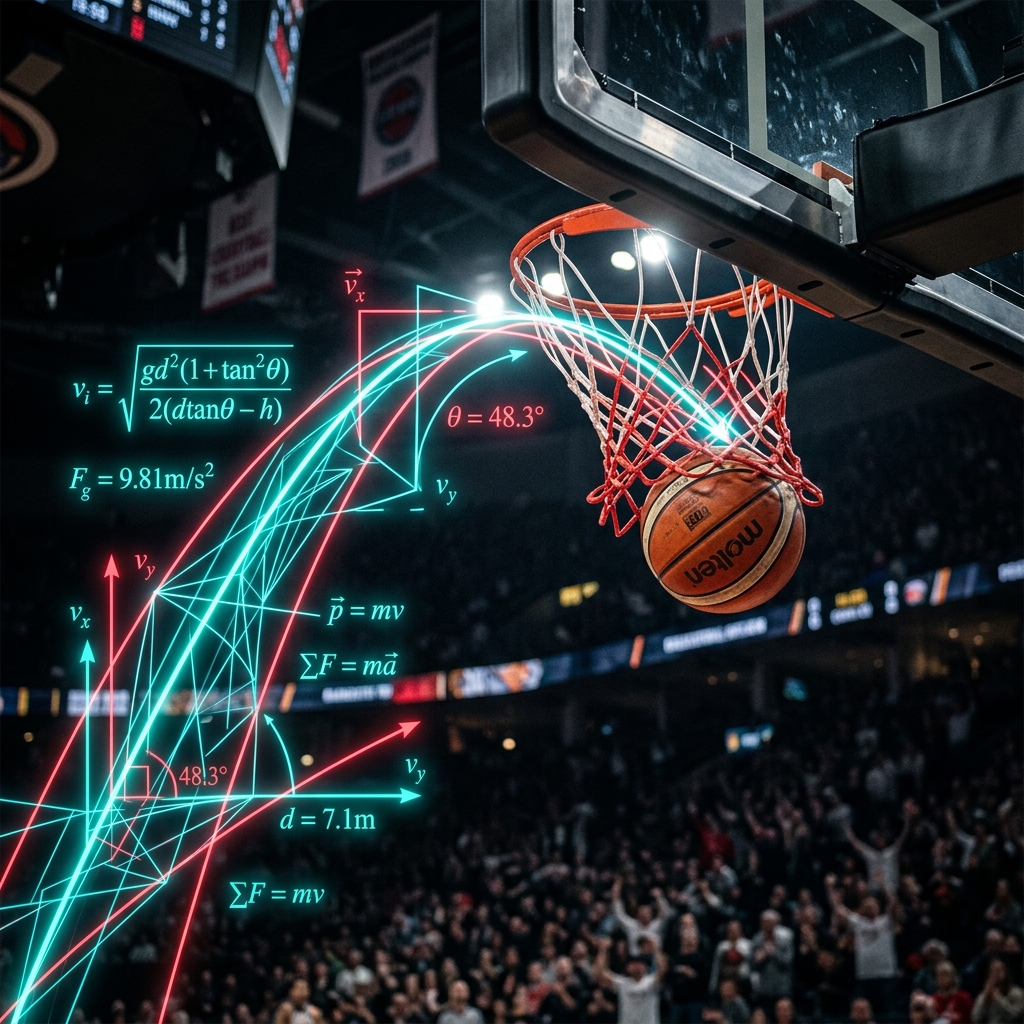
The central data point that Noah Basketball popularized is the entry angle of the ball into the rim. Research has shown that to maximize the probability of scoring, the ball must enter the basket at an angle between 43° and 47°. Below that, the ball hits the front rim and bounces off. Above that, it strikes the back rim. It is within this four-degree window that the secret to the perfect shot lies — and it is this window that AI systematically aims to hit.

📐 The geometry of the perfect shot: every degree of angle counts in the algorithmic analysis of the motion.
But Noah doesn't stop at the angle. The system also analyzes the ball's rotation speed (the famous backspin), the height of the release point, and the repetitive consistency of the motion. And this is where AI deploys all its power: where a human coach can give verbal feedback after a practice, Noah provides a score from 0 to 100 after each attempt, in less than two seconds. Players can instantly link physical sensation with quantitative feedback, creating a learning loop of unprecedented efficiency.
The results are striking. Players like Rudy Gay and DeAndre Jordan — who had never been known for their accuracy — transformed their free-throw percentages spectacularly after a few weeks of intensive use of the system. Entire teams have overhauled their training programs to integrate these daily shot analytics sessions. The boundary between physical preparation and data science has definitively vanished.
AI doesn't replace the player's instinct — it gives them a mirror their eyes cannot see alone. Every shot becomes a real-time lesson.
— NEXUS Analysis, NBA Shot Analytics 2026
Stephen Curry: the algorithmic architecture of a genius
If one looks for a human face to this algorithmic revolution, it wears number 30 for the Golden State Warriors. Stephen Curry is not just the greatest shooter in NBA history — he is, unintentionally, the reference model that dozens of algorithms attempt to replicate and teach to a new generation of basketball players.
The data science teams of the Warriors were among the first to adopt a fully quantitative approach to shot development. By analyzing Curry's thousands of practice repetitions, they documented a motion of almost supernatural consistency: a release point systematically located above the right eyebrow, an arc angle oscillating between 44° and 46.5°, a ball rotation of 2 to 2.4 revolutions per second, and perfect synchronization between leg extension and wrist flick. Parameters that Curry himself probably couldn't verbalize, but that his body executes with machine-like precision after years of deliberate practice.

🏀 The jump shot: beyond instinct, a biomechanical equation that AI breaks down point by point.
What is fascinating is that algorithmic analysis has highlighted aspects of Curry's motion that even his closest coaches hadn't fully realized. For instance, his ability to create release space using a slight torso tilt — an adjustment of just a few degrees — which allows him to shoot over much taller defenders. AI has not only documented this detail but has made it possible to teach it, with concrete results, to young players.
Today, startups like HomeCourt or ShotTracker have democratized these analyses that only existed in NBA training facilities just five years ago. By simply using a smartphone camera and computer vision algorithms, an amateur player can now get similar feedback in seconds from their neighborhood court. Curry's genius has become an algorithmic template accessible to all.
Real-time coaching by artificial intelligence
While post-session analysis has transformed practices, the true technological breakthrough lies in AI's ability to intervene during the exercise, in near real-time. Systems like Second Spectrum — the NBA's official data provider since 2017, whose technology was absorbed and amplified by Genius Sports — process game video feeds at 25 frames per second, generating cinematic data on every player at every moment.
During halftimes and timeouts, coaches no longer just look at carefully selected video clips. They consult AI dashboards that prioritize highlighting high-risk patterns: which players are performing below their usual efficiency curve, which opposing defensive matchups are most exploitable, what is the estimated fatigue level of each starter based on distance covered and sprint intensity. It is augmented, hybrid coaching, where human judgment is fed and accelerated by the machine.
Franchises like the Boston Celtics or the Phoenix Suns have pushed integration even further, developing their own proprietary analytics platforms. Assistant coaches carry connected tablets during practice, receiving alerts when a player deviates from their usual biomechanical parameters over several consecutive repetitions — an early signal of muscular fatigue or a bad habit forming. Injury prevention through AI, coupled with motion optimization, is poised to become the decisive competitive advantage of the decade.
When AI detects a 2° deviation in a player's elbow angle after 40 minutes of play, it sees something that even the world's best athletic trainer cannot perceive with the naked eye.
— NEXUS Report, Augmented Coaching in the NBA 2026
Democratization: from the NBA to neighborhood courts
For a long time, these technologies were the exclusive domain of NBA franchises, whose tech budgets run into the millions of dollars. But like any innovation, the diffusion cycle has been rapid, and what was reserved for yesterday's elite is becoming accessible to everyone.
The HomeCourt application, developed by the American startup of the same name and acquired by the NBA, perfectly illustrates this democratization. Using only the front camera of an iPhone or Android, the app automatically detects the player's position, the ball's trajectory, and the release point, thanks to computer vision models trained on millions of NBA shots. It then generates a detailed analysis report — arc, consistency, rhythm, shooting zones — available to any player in seconds, for free in its basic version.
In Europe, similar applications like Ballr or tools developed by FIBA as part of its digital development program are beginning to permeate youth clubs and training academies. In France, the National Basketball League launched a partnership in 2025 with several AI tech providers to equip Pro A training centers with motion analysis tools. The stated goal: to detect and train talent from age 14 using the same tools as those used by professionals.
However, this massive diffusion raises profound questions. If all players have access to the same optimization tools, does the competitive advantage diminish? Are we witnessing a standardization of motion that would threaten the diversity of styles — which is also part of the beauty of the game? Would figures like Charles Barkley or Shaquille O'Neal, whose free-throw shooting techniques were unorthodox to say the least, have been "corrected" by an algorithm before even reaching their full potential? This is the creative tension at the heart of the AI revolution in sports: to optimize without homogenizing, to improve without erasing what makes someone unique.
Conclusion: when AI becomes the coach
Basketball has never been a static sport. From George Mikan to Michael Jordan, from Magic Johnson to LeBron James, every generation has redefined what the human body is capable of achieving on a court. What artificial intelligence brings to this sport today is of a different nature — not a new way to play, but a new way to learn how to play.
The machine does not score points. It does not feel the pressure of the playoffs, the intoxication of a delirious crowd, or the pain of a heartbreaking defeat. What AI does, with relentless efficiency, is offer every player — whether an All-Star or a beginner — a mirror of unprecedented precision. A mirror that does not judge, does not get discouraged, and never stops analyzing.
In the coming years, advances in signal processing and multimodal language models will likely push boundaries even further: systems capable not only of analyzing motion but also of adapting advice in real-time to the player's emotional state, cognitive fatigue, or the specific tactical context of a game. AI will not be the coach — but it will be the indispensable tool that no top-level coach will be able to do without.
And perhaps that is the most important lesson of this entire revolution: human performance and artificial intelligence are not in opposition. They sculpt each other, in a dialogue where every perfect shot is both a victory for the athlete and a validation for the algorithm. The swish still echoes in the empty gym at 6 AM — but now, it is heard by a machine taking notes.


