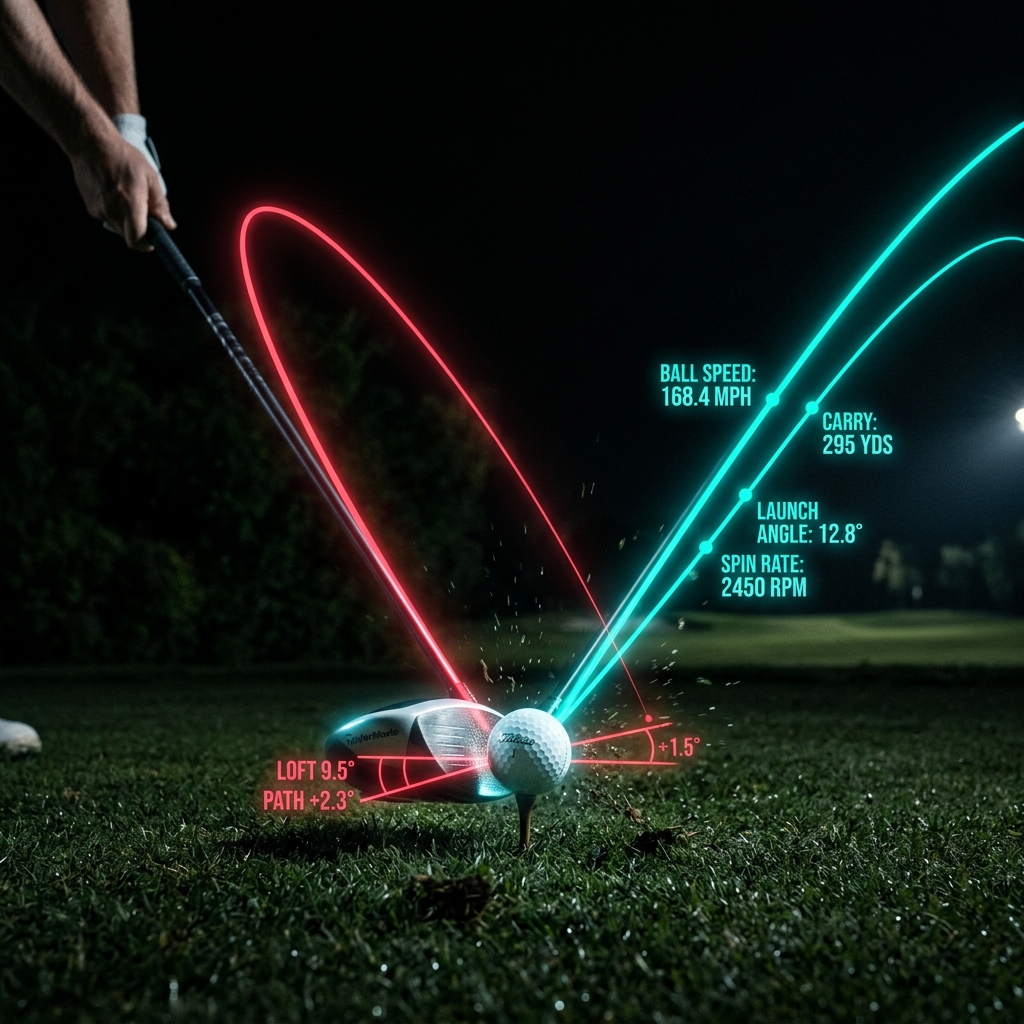
For decades, the golf swing remained a biomechanical enigma passed down through empiricism. From Ben Hogan to modern masters, the search for the perfect motion relied more on sensation and visual observation than on scientific certainty. But the point of impact of a golf club on the ball only lasts about 400 microseconds. A time lapse invisible to the naked eye, which nonetheless determines the entire trajectory of a ball propelled at over 250 km/h. Today, this fraction of a second is dissected with surgical precision, thanks to the convergence of two breakthrough technologies: Doppler radar and artificial intelligence via neural networks.
In the ecosystem of contemporary professional sports, intuition has given way to data science. Golf has become the ultimate playground for ballistic physics. At the heart of this revolution, swing analysis has transformed into an engineering discipline, allowing PGA Tour players to scrape the few performance percentages that separate a Major winner from the rest of the pack.
Doppler Radar: Capturing the Invisible
Originating from military missile tracking technologies, the use of Doppler radar in golf was pioneered by companies like TrackMan or FlightScope. The principle is simple in theory, but vertiginously complex in its execution: emit microwave signals and analyze the frequency shift of the signal reflected by the moving club and ball.
In a fraction of a second, these sophisticated radars generate more than 25 fundamental data points, measured with an error tolerance of less than 1%. Among them:
- Club Path: the direction in which the club head moves (inward or outward) at the moment of impact.
- Face Angle: the orientation of the club face relative to the target.
- Smash Factor: the ratio between the ball speed and the club speed, a true indicator of energy transfer efficiency.
- Spin Rate: fundamental for understanding lift (Magnus effect) and the curvature of the trajectory.
But capturing data is only the first half of the equation. Faced with this avalanche of numbers, the human brain, even that of the world's best coach, hits a wall of cognitive complexity. How to isolate the cause from the effect? How to understand the non-linear relationship between too steep an angle of attack and a "slice" trajectory without sacrificing club speed? This is where artificial intelligence enters the stage.
The Advent of Neural Networks
Artificial neural networks, inspired by the functioning of the human brain, excel in a specific area: recognizing complex patterns within massive datasets (Big Data). Leaders in golf technology have trained Deep Learning models on hundreds of millions of swings hit by golfers of all levels, from beginners to Masters winners.
These algorithms learn to correlate initial ballistic parameters (the cause) with the final trajectory of the ball (the effect). Even more impressive, modern predictive models can virtually "repair" a swing. The AI analyzes a player's Doppler radar data and, instead of merely listing their flaws, determines the exact biomechanical modification that will produce the best cost/benefit ratio for the athlete.
In practical terms, the algorithm "understands" that a one-degree modification in the club path is physiologically easier to achieve for a specific player than a change in the angle of attack, while producing a similar ball flight. This extreme personalization is the result of constant reinforcement learning.
Biomechanics, Computer Vision, and Prevention
The final frontier of this technological revolution combines Doppler radar with computer vision and AI-driven video analysis. High-speed cameras film the golfer while convolutional neural networks (CNNs) apply a 3D virtual skeleton onto the player's body in real-time, without needing the cumbersome physical sensors of the past.
This fusion of ballistic data (what the club does) and kinematic data (what the body does) opens unprecedented doors for performance, but above all for injury prevention. The modern golf swing generates monumental torsional stress on the lumbar spine. AI is now capable of alerting a player or their coach if their kinematic sequence (the order in which the pelvis, torso, arms, and club accelerate and decelerate) generates dangerous shear forces for their back.
The Democratization of High Technology
While these technologies were once reserved for the elite, Moore's Law and the optimization of AI models are changing the game. Today, consumer devices combine miniature radars with computing power offloaded to the cloud or directly on our smartphones.
Applications use the neural processing units (NPUs) of modern phones to run pose-estimation models in real-time, providing immediate voice feedback to the player on the driving range. Augmented reality (AR) is also stepping in, allowing the ballistic trace of the ball and force vectors to be superimposed directly on the smartphone screen, creating an immersive and highly engaging learning environment.
The future of golf is taking shape in data science laboratories. The next evolution will include digital twins of each golfer, allowing the simulation of swing progression and adaptation to new equipment in a fully virtual environment even before hitting the first ball on the course.
Conclusion
The integration of Doppler radar and neural networks in golf perfectly illustrates the philosophy of NEXUS magazine: technology is not here to distort the sport, but to reveal its purest essence. Golf will always remain a game of uncertainty, played on grass, subject to the whims of the wind and psychological pressure. However, the path to mastery, once paved with frustrating trial and error, is today illuminated by the cold and precise light of data. A revolution that allows every golfer, amateur or professional, to discover the mathematical potential of their own swing.