400 APM and the Overheated Brain
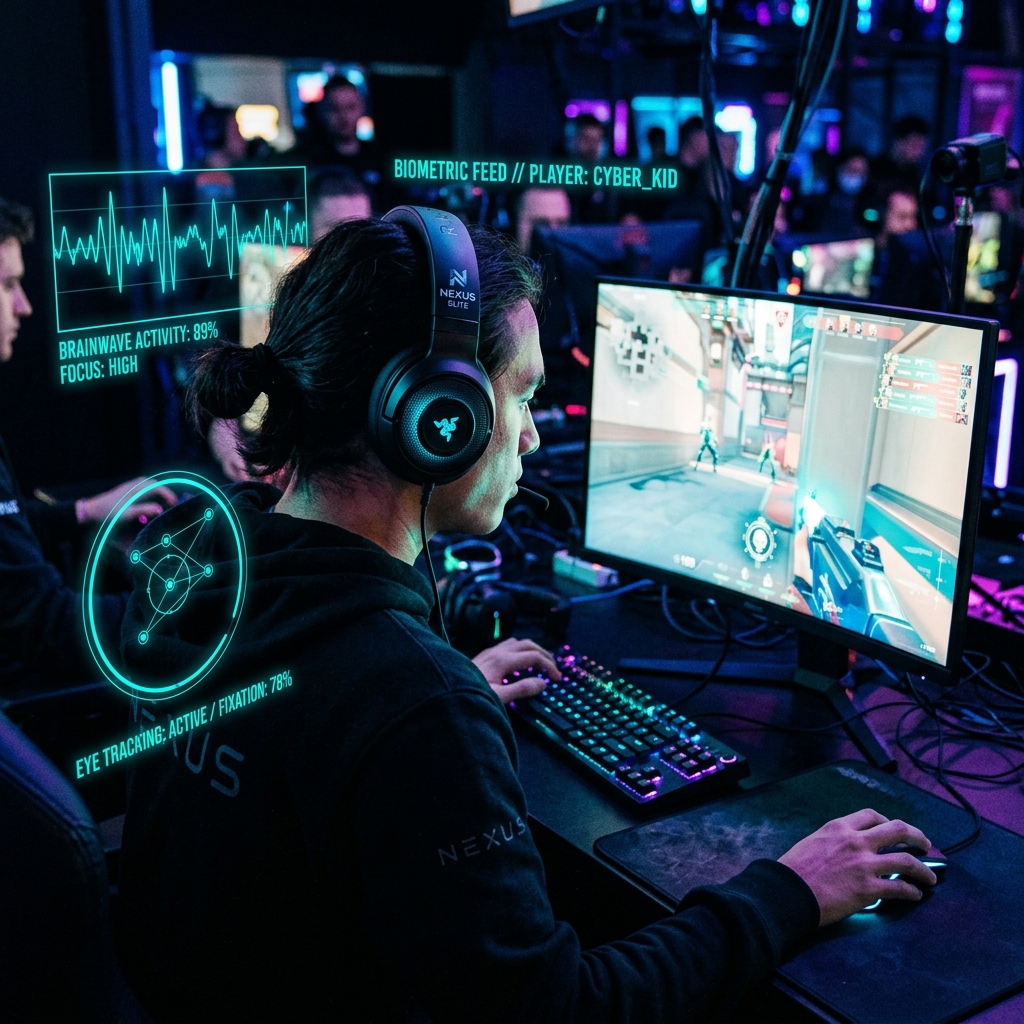
It's 10:47 PM, in the air-conditioned room of a training complex in Berlin. A Valorant Professional League player adjusts his headset, eyes fixed on his five screens. His coach isn't watching the main screen — he's scrutinizing a dashboard on his iPad. Heart rate: 162 bpm. Heart rate variability: dropping. Pupillary dilation: +38% compared to the baseline. The verdict comes silently in the manager's earpiece: "He's exhausted. Sub him out in ten minutes." No one in the stands will see it coming. But the algorithm predicted it four minutes ago.
Welcome to esport in 2026. A discipline that, over a decade, has transformed into a high-performance sport in its own right — with the measuring instruments to match. The 400 APM (actions per minute) of a top-tier League of Legends toplaner demand cognitive resources comparable to those of a fighter pilot in tactical stress, according to a study published in March 2026 by the German Institute for Sports Neuroscience. These hundreds of micro-decisions per minute — aiming, moving, activating a skill, communicating with teammates, adjusting the camera — generate a mental load that classic training methods can no longer measure or prevent.
It is into this void that biometrics and artificial intelligence have rushed. From electrodermal sensors to ultra-precise eye-tracking glasses, through fourth-generation EEG headbands and predictive burnout algorithms, the technological ecosystem of the modern professional player looks more like a neuroscience lab than a simple gaming room. The question now dividing the entire community is twofold: do these tools make better champions? And at what human cost?
The data is staggering. According to a report by ESL / FACEIT Group published in January 2026, 73% of top global esport organizations — those with annual budgets exceeding five million euros — have integrated at least one biometric monitoring device into their training protocol. This figure was 12% in 2021. The revolution is not just beginning: it is already here, it is silent, and it is fundamentally redrawing what it means to be a professional in a discipline where the body, long relegated to the background, has become the most strategic variable of all.
Eye-Tracking: When the Pupil Betrays Cognitive Fatigue

The eye doesn't lie. This is the premise behind next-generation eye-tracking systems deployed by major esport organizations since 2024. The pupil, that black disc in the center of the iris, is directly connected to the autonomic nervous system. It dilates under adrenaline, contracts during calm, and its reactivity to visual stimuli is a reliable marker of instantaneous cognitive load — far more honest, in any case, than what the player can tell you about their own state.
Eye-tracking cameras embedded in new generation gaming monitors — notably the Tobii Pro Spark 2 and the EyeNeo modules integrated into LG UltraGear OLED 27" screens — capture up to 1,200 data points per second. They analyze not just where the player is looking on the screen, but how their eyes move. Ocular saccades — those sudden, involuntary movements — gradually slow down with fatigue. A player in top form makes precise, anticipatory saccades; an exhausted player produces erratic movements, reactive rather than proactive. The difference is imperceptible to the naked eye. But not for an algorithm trained on 40,000 hours of professional matches.
"When a player's ocular saccades lose precision and anticipation, we know they've lost 15 to 20% of their decision-making capabilities — before they even realize it themselves."
— Dr. Léa Fontaine, Sports Neuroscientist, University of Paris-Saclay, 2026Beyond simply measuring fatigue, eye-tracking reveals players' unconscious strategic patterns. Coaches for T1 teams in LCK and Fnatic in LEC now use real-time gaze heatmaps to analyze their players' cognitive blind spots: which areas of the minimap are neglected under pressure? At what precise moment does the support stop watching enemy positions to focus exclusively on their carry? This information, impossible to obtain through human observation, becomes highly targeted training levers. They no longer just work on macro-play in theory — they work, frame by frame, on visual habits deeply anchored in the player's nervous system.
The Tobii Pro Spark 2 offers tracking accuracy of 0.3° visual angle, 2ms latency, and integrates directly into pro teams' video analysis protocols. Compatible with analysis platforms like SynergyPro and GameCoach AI. Estimated price: €1,890 for organizations.
Valorant, LoL, CS2: Pro Teams Under Neural Surveillance

The Natus Vincere Counter-Strike 2 roster is the first team to have made its entire biometric protocol public in November 2025. At each training session, the five players wear a modified Whoop 5.0 wristband, a Muse S Pro EEG headband, and play on screens equipped with eye-tracking modules. A central system — dubbed NaVi Neural Hub — aggregates all this data and runs it through a proprietary machine learning model that generates a "Neural Performance Score" for each player every five minutes. This score, visible only to the head coach and medical staff, directly influences training rotations, forced break times, and team compositions for tournaments.
In League of Legends, T1 — Faker's Korean organization — has gone even further. Their R&D department, in collaboration with Samsung Health and KAIST (Korea Advanced Institute of Science and Technology), has developed a "Performance Mapping" protocol that correlates players' biometric data with their in-game metrics: damage ratio, vision score, correct decision rate in team fights. The AI thus identifies the time slots when each player is biologically at their peak capacity — and optimizes training sessions accordingly. Faker stated in an exclusive interview with NEXUS in April 2026: "The machine told me I was at my best between 2:00 PM and 5:30 PM. I would never have guessed it myself — I would have said the evening."
The Valorant ecosystem, via the VCT (Valorant Champions Tour), has seen a French startup emerge at the center of discussions: CogniForge, founded in Lyon in 2024, offers a complete suite of biometric analysis specifically calibrated for competitive FPS games. Their algorithm measures "pre-round micro-anxiety" — the measurable cortisol spike in finger sweat in the 8 seconds preceding the start of a round — allowing coaches to identify players likely to make mistakes under pressure before they even happen. Sentinels, Loud, and Team Heretics are among their official clients.
A booming market: The global market for biometrics applied to esport is estimated at 340 million euros in 2026, up from 48 million in 2022 — a sevenfold increase in four years. Analysts at Deloitte Digital Sport project one billion euros by 2029, driven by increasing integration in semi-pro and collegiate leagues.


