FR | EN | ES

Climbing: Route Generation and 3D Center of Gravity via Computer Vision

Partager l'article : 𝕏 Twitter 💼 LinkedIn 📘 Facebook
Climber analyzed by artificial intelligence

With chalk-whitened hands and short breath, the climber stares at the wall. Before him lies an apparent chaos of colorful holds. In his mind, a complex biomechanical puzzle is falling into place. Until recently, indoor climbing was a matter of intuition, empirical experience, and brute strength. But in the age of data, the climbing wall has become a high-tech laboratory. Artificial intelligence, coupled with computer vision, is no longer just filming the exploits of athletes: it dissects gravity, models perfect balance, and even generates custom routes to force progression.

For amateur climbers stuck on a progression plateau as well as for Olympic athletes in search of the perfect movement, the revolution is here. Smart cameras and deep learning algorithms transform the climbing gym into an augmented environment where every weight transfer is scrutinized with millimeter precision. Dive into the heart of a discipline where the algorithm becomes the most demanding route setter.

Advertisement

Computer Vision for Wall Mapping

The first technological challenge in climbing analysis lies in understanding the environment: the wall. Unlike a standard-sized football field, a bouldering wall evolves every week. The "setters" (the designers of the routes) unscrew, turn, and replace hundreds of holds to create new physical puzzles.

This is where computer vision comes into play. Multi-camera systems equipped with LiDAR sensors (similar to those in autonomous vehicles) scan the wall in real time. In a few seconds, the AI generates a 3D digital twin of the wall. The deep learning algorithm, trained on tens of thousands of hold models (from microscopic "crimps" to monumental "slopers"), identifies not only the spatial position of each hold, but also evaluates its inclination, its probable texture, and its optimal grip (the famous "sweet spot").

Climber on a complex bouldering wall
Computer vision models the inclination and grip of each hold in real time.

This dynamic mapping allows the system to understand the playground even before the climber sets off. The wall is no longer an inert vertical surface, but a three-dimensional data matrix. The AI calculates the Euclidean distances between holds, estimates the necessary traction angles, and identifies potential rest zones. This is the essential foundation for the next step: analyzing human movement on this uneven terrain.

Center of Gravity and Biomechanics Analysis

In climbing, arm strength is secondary to a fundamental concept: the placement of the center of gravity. An expert climber knows how to position their pelvis to maximize support on their feet, thus saving the precious energy of their forearms. Measuring this phenomenon was previously reserved for biomechanics laboratories laden with sensors attached to the athlete's body.

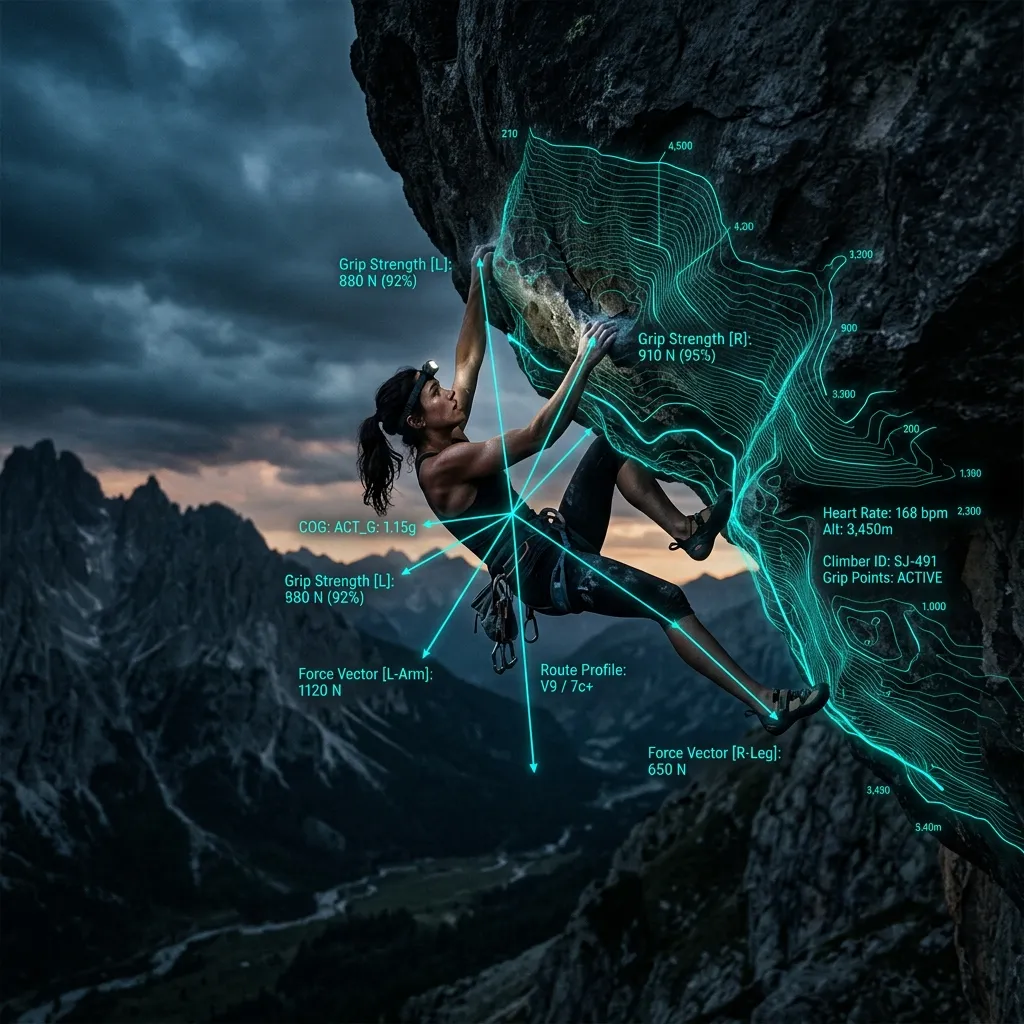
Today, "markerless" video analysis (without body sensors) is revolutionizing this approach. Pose estimation algorithms, based on state-of-the-art convolutional neural architectures, track the climber's 33 major articulation points live. Even when an arm is hidden by the body in a twisting movement (the famous "drop knee"), the AI infers its position with an accuracy rate exceeding 94%.

"The real magic happens when the algorithm no longer looks at the climber's hands, but at the invisible trajectory of their pelvis. That is where the truth of gravity lies." — Dr. Elena Rostova, Sports Biomechanics Engineer

By combining the climber's estimated body mass and the position of their skeleton tracked in 3D space, the software dynamically calculates the center of gravity. On screen, for the coach, this translates into a red dot floating over the video image. If this red dot moves too far from the axis of the foothold during a dynamic movement (a "dyno"), the AI instantly alerts to a loss of energy efficiency or an imminent risk of falling. Post-session analysis allows the climber to visualize exactly at which millisecond their pelvis drifted off-axis, causing the failure of their ascent.

Generative Route Setting: When AI Creates the Perfect Route

If AI excels in analysis, its generative capacity opens up dizzying prospects. Modern bouldering gyms now rely on algorithms to generate "routes" on connected walls like the Kilter Board or MoonBoard. But the new generation of algorithms goes much further by offering a "generative setting" based on the user's biomechanical profile.

Imagine a climber measuring 1.70m, with excellent grip strength but lacking hip flexibility. After analyzing several of their sessions, the AI draws up their "weakness profile". The algorithm will then virtually design a route specifically calibrated to force them to work on their hip flexibility, while ensuring that the movements remain morphologically possible for their wingspan (their "ape index").

Advertisement

The system takes into account thousands of parameters: the type of holds available in the gym's stock, the inclination of the wall, the residual friction of the volumes. Using lasers or LEDs integrated into the wall, the AI illuminates the generated path. If the climber succeeds too easily, the neural network adjusts the difficulty for the next generation, creating a principle of "adaptive progressive overload" managed entirely by the machine.

Climber using an interactive connected wall
Connected walls now interact in real time with the athlete's biometric data.

The Future: The Virtual Coach and Augmented Reality

What does the next step hold for us? The fusion of real-time 3D video analysis and augmented reality. AR sports glasses prototypes currently being tested in high-performance centers allow the "beta" (the optimal method for succeeding the route) to be projected directly into the climber's field of vision before they even leave the ground.

Even better, thanks to haptic feedback or real-time audio coaching broadcast into bone-conduction earpieces, the AI can whisper crucial adjustments mid-effort: "Lower your pelvis by 3 centimeters to the left", "Your heart rate indicates you must use the next rest". The climber is no longer alone on the wall; they become one with an algorithmic ecosystem designed to push them beyond their perceived physical limits.

By pushing the boundaries of video analysis and 3D modeling of human movement, technology is redefining the very essence of climbing. The ascent is no longer just a poetic struggle against Earth's gravity: it is a sublime and complex mathematical problem that man and machine now solve together.

Advertisement