Professional cycling has passed the point of no return. The romantic era where the race was won solely "by feeling" and panache on the slopes of Mont Ventoux or Alpe d'Huez is definitively over. Today, behind every breakaway, behind every pedal stroke and every team relay, lies an invisible technological infrastructure, fueled by billions of data points and orchestrated by Artificial Intelligence.
On the Tour de France, the war is no longer limited to watts per kilo (W/kg). It is now fought in servers, where predictive models calculate aerodynamic drag to the exact millisecond, and where machine learning algorithms smooth riders' power curves to optimize their glycogen use. Dive into the era of "augmented cycling", where the algorithm has become the shadow sporting director.
Aerodynamics 2.0: When CFD Replaces the Wind
Historically, aerodynamic optimization required costly hours in a physical wind tunnel. Today, top teams like Visma-Lease a Bike, UAE Team Emirates, or Ineos Grenadiers rely heavily on CFD (Computational Fluid Dynamics) coupled with AI. The wind tunnel has become virtual.
CFD numerically simulates the behavior of air around the rider, their bike, and even the entire peloton. Deep learning algorithms analyze these massive simulations to identify micro-optimizations that the human eye or a single engineer could not detect. They virtually modify the shape of a helmet, the roughness of a fabric around the shoulders, or the precise angle of time-trial aero bars, testing tens of thousands of iterations a night.
Even more impressively, AI now models the "slipstream effect" of a continuously moving peloton. Teams know exactly, to the watt, how much energy a rider saves depending on their exact position, wind direction (updated in real time via GPS weather data), and the physical build of the riders ahead of them.

Postural optimization down to the millimeter, guided by fluid simulation algorithms.
Smoothed Power: The End of Bonking?
The power meter revolutionized training two decades ago. AI is elevating it today. Modern sensors no longer just transmit a raw number (watts) to the head unit screen. They incorporate sophisticated signal processing algorithms.
In a race, the power produced by a rider is inherently erratic (accelerations, standing up, headwinds). New algorithmic models for "predictive smoothed power" integrate heart rate data, estimated core temperature, lactic acid levels (extrapolated from heart rate variability), and the upcoming topographical profile.
AI thus calculates, in real time, the precise state of the rider's "energy tank" (the famous anaerobic work capacity, or W'). The head unit no longer just displays "400 watts", but tells the rider: "At this power, metabolic failure in 3 minutes and 42 seconds". The rider can smooth their effort to the extreme limit of breaking, eliminating the spectacular "bonks" or explosions once seen on major climbs.
Digital Twin and Team Strategy
The true technological revolution in the peloton lies in the use of "Digital Twins". Before the start of a key Tour de France stage, the teams' supercomputers have already simulated the race tens of thousands of times.
Each rider on the team has their digital twin, modeled according to their peak weight, record power profile, aerodynamic drag coefficient (CdA), accumulated fatigue from previous stages, and even their sleep quality the night before.
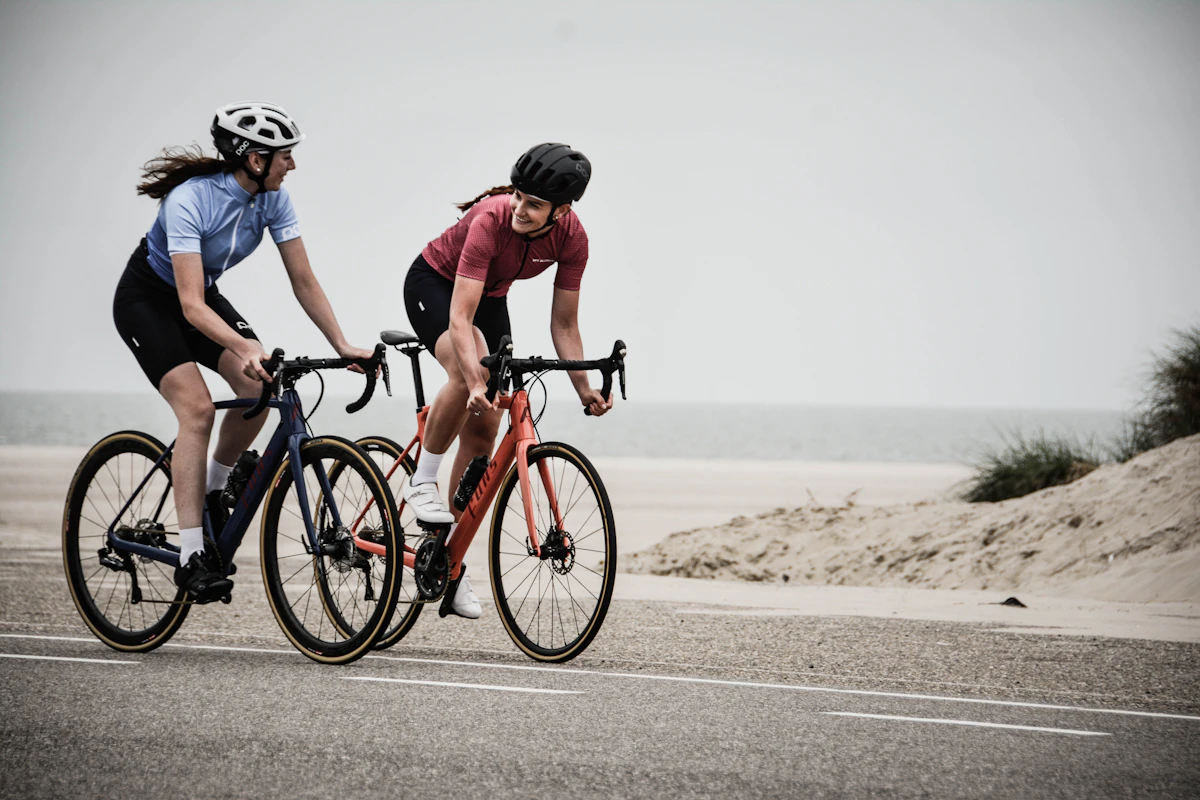
The peloton today is a complex network of living data processed by the sporting directors' AIs.
When a breakaway forms, the sporting director in the car no longer needs to guess whether to chase or not. The AI receives the composition of the breakaway, evaluates the profile of the riders present, cross-references with the expected crosswinds at kilometer 120, and gives a probability of success as a percentage.
If the AI recommends chasing, it dictates exactly which teammate should take a pull, at what specific power, and for how many kilometers to optimize team energy without burning out the mountain lieutenants. It's a hyper-mathematized game of chess where chance is reduced to its strict physiological minimum.
Humanity Remains the Engine, AI Becomes the Compass
Some purists fear that this excessive technologization is killing the spectacle. The algorithm encourages smoothing the effort, penalizing long-range attacks deemed mathematically irrational. Yet, uncertainty remains.
An algorithm, however powerful, cannot model courage, psychological pressure in the July rain, or the pure instinct of a champion who decides to throw the plan out the window 50 kilometers from the finish line. Artificial Intelligence has given cycling its virtual wind tunnel and smoothed power. It has perfected the machine and guided the human. But in the end, on the 12% slopes of the Col de la Loze, it is always the muscle fibers, the heart, and the willpower that must transform algorithmic prediction into victory. And that is exactly where the beauty of this hybrid sport lies.